Key Facts
- Fights at Valmy and Jemappes in 1792, a general at nineteen
- Leaves France in 1793 and begins an exile of more than twenty years
- Marries Maria Amalia of Naples and Sicily in 1809
- Becomes King of the French on 9 August 1830, after the July Revolution
- Pursues the conquest of Algeria under the July Monarchy
- Abdicates on 24 February 1848 and goes into exile in England
- Dies at Claremont on 26 August 1850
Biography
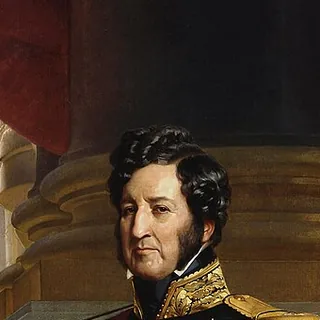
Louis Philippe I (1773-1850), King of the French from 1830 to 1848, was the last king to reign over France. Brought to power by the July Revolution, this prince of the cadet Orléans branch embodied a constitutional and liberal monarchy favourable to the bourgeoisie, before he in turn was overthrown by the February Revolution of 1848.
Born in Paris on 6 October 1773, at the Palais-Royal, he was the eldest son of the Duke of Orléans, who during the Revolution took the name Philippe Égalité. Won over by the new ideas, he attended the Jacobin Club under the title of Duke of Chartres and became an officer in the revolutionary army: a general at nineteen, he fought at Valmy and Jemappes in 1792, then at Neerwinden in 1793. That same year he broke with the Republic, just as it was sending Louis XVI to the scaffold, and left France; his father was guillotined at the end of 1793.
There followed an exile of more than twenty years, which took him to Switzerland, Scandinavia, the United States, Cuba and England. In 1809 he married Maria Amalia of Naples and Sicily. Having returned to France under the Restoration, in 1814, he led the life of a prince of the blood with a modest air while increasing his fortune.
In July 1830 the “Three Glorious Days” overthrew his cousin Charles X. Appointed lieutenant general of the kingdom, then proclaimed by the Chamber of Deputies, Louis Philippe became “King of the French”, no longer King of France, on 9 August 1830; he was never crowned. The July Monarchy was a parliamentary regime that sought a “middle way” between reaction and revolution, encouraged industrial and financial growth and pursued friendship with Britain. It benefited above all the industrialists and bankers who dominated political life. It also pursued the conquest of Algeria, begun in 1830. After 1840, under the influence of François Guizot, the government grew more conservative.
The king refused to widen the electorate, which was restricted to the wealthiest. The economic crisis of 1847 and the discontent of workers and of part of the elite led to the February Revolution of 1848: on 24 February Louis Philippe abdicated in favour of his grandson, the Count of Paris, and fled to England, where he died at Claremont on 26 August 1850. The Second Republic was proclaimed. Nicknamed the “Citizen King”, he remains the last monarch to have borne the title of king in France.
Sources: Wikipédia, « Louis-Philippe Ier »; Wikipedia, « Louis Philippe I »
Kings of France (1830-1848)
Related event
Also worth discovering
Last updated: