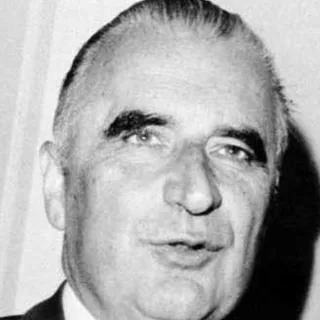
Key Facts
- 5 July 1911: born in Montboudif (Cantal)
- 1958: chief of staff to General de Gaulle
- 14 April 1962: appointed Prime Minister
- May 1968: negotiation of the Grenelle agreements
- 15 June 1969: elected President of the Republic
- 1973: the United Kingdom joins the European Community
- 2 April 1974: dies in office in Paris
Biography
Georges Pompidou (1911-1974), Prime Minister from 1962 to 1968 and then President of the Republic from 1969 until his death, succeeded General de Gaulle at the head of the Fifth Republic. A graduate of the École normale supérieure and a literature teacher turned banker, he embodied the industrial modernisation of France during the post-war boom. He is the only President of the Fifth Republic to have died in office.
Born on 5 July 1911 in Montboudif, in the Cantal, into a family of modest origins, he entered the École normale supérieure, passed the agrégation in literature and taught for several years. At the Liberation he joined General de Gaulle's circle, to which he would remain loyal. In the 1950s he joined the Rothschild bank, where he became general manager. As de Gaulle's chief of staff in 1958, he helped set up the Fifth Republic, then sat on the Constitutional Council from 1959 to 1962.
On 14 April 1962 de Gaulle appointed him Prime Minister, although he had never been elected. After a motion of censure against his government was passed in October 1962, de Gaulle dissolved the National Assembly and the Gaullists won the elections. The Pompidou government launched major modernisation programmes: regional development, motorways, the Concorde airliner, computing. In May 1968, faced with the student revolt and the general strike, he negotiated the Grenelle agreements with the unions and employers. De Gaulle nevertheless replaced him in July 1968. He still holds the record for the longest tenure as Prime Minister under the Fifth Republic.
After de Gaulle's resignation, he was elected President of the Republic on 15 June 1969, with 58% of the second-round vote against Alain Poher. He pursued the modernisation of the country: support for large industrial groups, the launch of the TGV and of the civil nuclear programme, the creation of the minimum wage (SMIC) and of the first Ministry of the Environment. In foreign policy, he lifted French opposition to the United Kingdom's entry into the European Community, which took effect in 1973. A lover of modern art and the author of an anthology of French poetry, he launched the project for a major centre of contemporary art in Paris, which opened in 1977 as the Centre Georges Pompidou.
Suffering from a rare form of blood cancer, Waldenström's macroglobulinaemia, he concealed the seriousness of his condition. He died in office in Paris on 2 April 1974, aged sixty-two, two years before the end of his term. His death led to an early election, won by Valéry Giscard d'Estaing. The secrecy surrounding his illness fuelled the debate on transparency about presidents' health. He had married Claude Cahour in 1935; the couple had adopted a son, Alain.
Sources: Wikipédia, « Georges Pompidou »; Wikipedia, « Georges Pompidou »
French heads of government (1962-1968)
French Presidents (1969-1974)
Also worth discovering
Last updated: