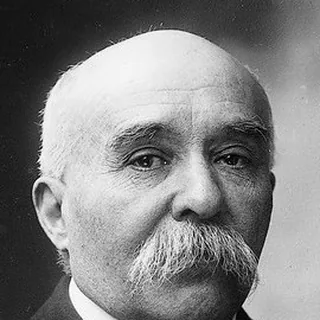
Key Facts
- 28 September 1841: born in Mouilleron-en-Pareds (Vendée)
- 1870: Mayor of Montmartre during the siege of Paris
- 13 January 1898: publishes Émile Zola's letter in L'Aurore under the title J'accuse...!
- 1906-1909: Prime Minister
- 16 November 1917: Prime Minister again
- 28 June 1919: signing of the Treaty of Versailles
- 24 November 1929: dies in Paris
Biography
Georges Clemenceau (1841-1929), a physician, journalist and statesman, is one of the leading figures of the Third Republic. Leader of the Radicals, so feared for his combativeness that he was nicknamed “the Tiger”, a defender of Dreyfus and twice Prime Minister, he led France to victory in 1918, which earned him the nickname of “Father Victory”.
Born on 28 September 1841 in Mouilleron-en-Pareds, in the Vendée, into a republican family, he studied medicine in Paris, where he defended his thesis in 1865. He then left for the United States, where he lived until 1869 as a journalist and teacher, and married an American, Mary Plummer. Back in France, he became mayor of the Paris district of Montmartre in 1870, during the siege of Paris.
A deputy from 1876 and the leader of the Radicals, he demanded an amnesty for the Communards and the separation of the Churches and the State, and earned a reputation as a “toppler of ministries”: notably, in 1885 he helped bring down Jules Ferry, whose colonial policy he opposed. Tarnished by the Panama scandal, he lost his seat in 1893 and devoted himself to journalism. Committed to the defence of Dreyfus, on 13 January 1898 he published in L'Aurore Émile Zola's open letter to the President of the Republic, giving it its title: “J'accuse...!”.
Elected senator for the Var in 1902, he became Minister of the Interior in 1906 and then Prime Minister, from October 1906 to July 1909. Styling himself “France's top cop”, he modernised the police but harshly suppressed strikes and the revolt of the winegrowers of the Midi, which set him at odds with the Socialists and with Jean Jaurès. During the First World War he fiercely criticised the conduct of the conflict in his newspaper, L'Homme enchaîné.
On 16 November 1917, at the height of the crisis, President Raymond Poincaré called on him to become Prime Minister. He waged a policy of total war, hunted down defeatists and supported the single command entrusted to Foch. After the armistice of 11 November 1918, he presided over the peace conference and, against the American President Woodrow Wilson, pressed for harsh terms for Germany, set out in the Treaty of Versailles signed on 28 June 1919. Wounded by an anarchist in February 1919, he carried the bullet in his body until his death. Passed over in favour of Paul Deschanel in the presidential election of January 1920, he withdrew from political life. He died in Paris on 24 November 1929, aged eighty-eight, and lies in his native Vendée.
Sources: Wikipédia, « Georges Clemenceau »; Wikipedia, « Georges Clemenceau »
French heads of government (1906-1909)
French heads of government (1917-1920)
Related event
Also worth discovering
Last updated: