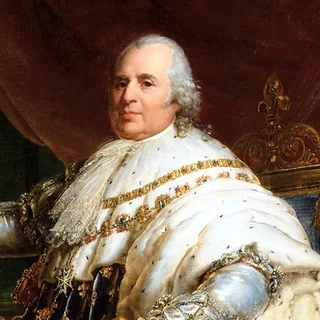
Key Facts
- Bears the title of Count of Provence as brother of the future Louis XVI
- Leaves France in 1791 and begins an exile of more than twenty years
- Proclaims himself king in 1795, on the death of Louis XVII
- Returns to France in 1814 and grants the Constitutional Charter
- Flees during the Hundred Days and regains his throne in July 1815
- Dissolves the Chambre introuvable in 1816
- Dies at the Tuileries on 16 September 1824
Biography
Louis XVIII (1755-1824), King of France and Navarre from 1814 to 1824, with the interruption of the Hundred Days, was the monarch of the Restoration. A brother of Louis XVI, he returned from more than twenty years in exile after Napoleon's fall and gave France a constitutional monarchy with the Charter of 1814. He was the last King of France to die on the throne.
Born at the Palace of Versailles on 17 November 1755, Louis Stanislas Xavier of France was the grandson of King Louis XV and the son of the Dauphin Louis. A younger brother of the future Louis XVI, he bore the title of Count of Provence. When the Revolution broke out he at first stayed in France, then left the country in 1791, the same year as his brother's failed attempt to flee.
There followed an exile of some twenty-three years, which took him in particular to Prussia, Russia and Great Britain. In 1795, after his nephew, the young Louis XVII, died in prison, he proclaimed himself king and the royalists recognised him as such, although he was unable to reign. Throughout the Napoleonic era he waited for the monarchy to be restored.
That moment came in 1814: after the Allied victories and Napoleon's abdication in April, Louis XVIII returned to Paris: the Bourbons regained the throne from which the monarchy had been removed in 1792. He granted the Constitutional Charter, which guaranteed equality before the law and created a parliamentary regime, with a Chamber of Peers and a Chamber of Deputies elected by a property-based franchise. In 1815, however, the return of Napoleon, who had escaped from Elba, forced him to flee: these were the Hundred Days. After Waterloo, the Allies restored him to the throne in July 1815.
The Second Restoration began with a wave of violence, the White Terror, led by the ultra-royalists. The king, who sought to reconcile the legacy of the Ancien Régime with the gains of the Revolution and the Empire, dissolved in 1816 the “Chambre introuvable”, which the ultras dominated. In 1818 France joined its former conquerors in the Quintuple Alliance. The assassination of his nephew, the Duke of Berry, in 1820 nevertheless tipped power towards the ultras, with the Villèle ministry; in 1823 a military expedition restored the King of Spain's authority. Louis XVIII died childless at the Tuileries on 16 September 1824, and his brother succeeded him as Charles X.
Sources: Wikipédia, « Louis XVIII »; Wikipedia, « Louis XVIII »
Kings of France (1814-1824)
Related event
Also worth discovering
Last updated: