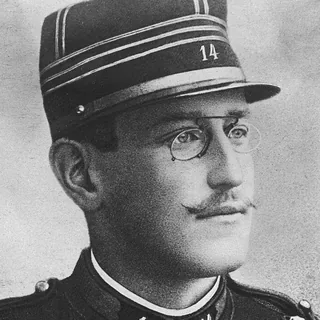
Key Facts
- 9 October 1859: born in Mulhouse
- 1878: enters the École Polytechnique
- 22 December 1894: wrongly convicted by a court martial
- 1895-1899: held on Devil's Island
- 19 September 1899: pardoned by President Loubet
- 12 July 1906: exonerated by the Court of Cassation
- 12 July 1935: dies in Paris
Biography
Alfred Dreyfus (1859-1935), a French artillery officer of Alsatian origin and Jewish faith, was the victim of the miscarriage of justice that gave its name to the Dreyfus affair. Wrongly convicted of treason in 1894, degraded and deported to Devil's Island, he never stopped proclaiming his innocence during the twelve years of struggle that divided France, until his exoneration in 1906. He went on to serve in the First World War.
Born in Mulhouse on 9 October 1859 into a family of textile manufacturers, he was eleven when Alsace was annexed by Germany in 1871: his family chose to remain French, and he went to continue his studies in Paris. Admitted to the École Polytechnique in 1878, he became an artillery officer and then entered the École Supérieure de Guerre, graduating among the top of his class in 1892. In 1890 he married Lucie Hadamard, who would be his main support. In 1893 he was posted as a probationer to the army's General Staff in Paris.
In October 1894, accused of writing a bordereau offering military documents to Germany, he was arrested and sentenced by a court martial to deportation for life. On 5 January 1895 he was degraded in the courtyard of the École Militaire, crying out: “Long live France! I am innocent!” Held in a hut on Devil's Island, in French Guiana, he lived there for more than four years in very harsh conditions, shackled at night for several weeks in 1896, knowing nothing of the campaign waged in France by his brother Mathieu and the Dreyfusards.
Brought back to France in 1899 for a retrial at Rennes, he was convicted again, with extenuating circumstances, and then pardoned by President Émile Loubet in September. He accepted the pardon while continuing to demand justice, and in 1901 published an account of his imprisonment, Five Years of My Life. On 12 July 1906 the Court of Cassation quashed the Rennes verdict: reinstated in the army with the rank of major, he received the Legion of Honour in the very courtyard of the École Militaire. In 1908, during the transfer of Émile Zola's ashes to the Panthéon, he was wounded by a nationalist journalist who shot at him.
Retired in 1907, he was recalled to service during the First World War, fought notably at Verdun and on the Chemin des Dames, and ended the war as a lieutenant-colonel. He died in Paris on 12 July 1935, aged seventy-five, and was buried in Montparnasse Cemetery. His name remains the symbol of the struggle against injustice and antisemitism, and the League of Human Rights, born of his case, carries on its fight.
Sources: Wikipédia, « Alfred Dreyfus »; Wikipedia, « Alfred Dreyfus »
Related event
Also worth discovering
Last updated: