Key Facts
- 6 September 1854: born in Strasbourg
- July 1895: head of the intelligence service
- March 1896: discovers Esterhazy's guilt
- February 1898: testifies at Émile Zola's trial
- 1898-1899: imprisoned
- October 1906: Minister of War
- 19 January 1914: dies in Amiens
Biography
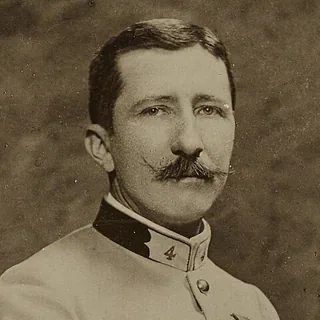
Georges Picquart (1854-1914), a French officer, was the man who discovered the real culprit in the Dreyfus affair. Head of counter-intelligence, in 1896 he identified Major Esterhazy as the author of the treason attributed to Captain Dreyfus and refused to stay silent, at the cost of his career and his freedom. Exonerated in 1906, he became Minister of War in Georges Clemenceau's government.
Born in Strasbourg on 6 September 1854 into a family of civil servants and soldiers, he was sixteen when Alsace was annexed by Germany; his family chose France. Admitted to Saint-Cyr in 1872, he graduated among the top of his class and then entered the staff college. A brilliant, cultured officer who spoke several languages, he served in Tonkin in the 1880s before teaching topography at the École Supérieure de Guerre, where one of his pupils was Captain Alfred Dreyfus.
Present at Dreyfus's trial in 1894, he was convinced of his guilt. Appointed head of the intelligence service in July 1895, in March 1896 he intercepted a telegram, the “petit bleu”, sent to Major Esterhazy by the German military attaché. Comparing handwriting, he discovered that the bordereau that had convicted Dreyfus was in Esterhazy's hand. His superiors refused to reopen the case, and at the end of the year he was sent away to Tunisia.
Before leaving he confided his secret to a lawyer friend, which allowed the Dreyfusards to learn the truth. A witness against the General Staff at Esterhazy's trial and then at Émile Zola's in February 1898, he was dismissed from the army and imprisoned for almost a year, accused of disclosing secret documents. Released in June 1899, he refused to benefit from the amnesty law of 1900 and went on demanding the truth, without ever having felt any particular sympathy for Dreyfus himself.
In July 1906, at the same time as Dreyfus, he was reinstated in the army with the rank of brigadier general. A few months later Georges Clemenceau appointed him Minister of War, a post he held from October 1906 to July 1909: the Prime Minister, formerly a leading writer at L'Aurore, thus made him the symbol of the redress owed to the Affair's victims. Promoted to major general, he took command of the 2nd Army Corps at Amiens. He died there on 19 January 1914, aged fifty-nine, from the effects of a fall from his horse. The film director Roman Polanski retold his struggle in the film An Officer and a Spy, released in 2019.
Sources: Wikipédia, « Marie-Georges Picquart »; Wikipedia, « Georges Picquart »
Related event
Also worth discovering
Last updated: