Key Facts
- c. 428 BC: born in Athens
- c. 408 BC: becomes a disciple of Socrates
- 399 BC: death of Socrates
- c. 387 BC: founds the Academy in Athens
- c. 375 BC: the Republic
- 367 and 361 BC: stays in Syracuse with Dionysius II
- c. 348 BC: dies in Athens
Biography
Plato (c. 428-348 BC), an Athenian philosopher, the disciple of Socrates and teacher of Aristotle, is one of the most influential thinkers in history. The founder of the Academy, the first great school of philosophy, he left some thirty dialogues, including the Republic, the Symposium and the Phaedo. His theory of Forms and his reflection on the just city have shaped all Western thought, from Antiquity to Christianity and modern philosophy.
Born around 428 BC in Athens into an aristocratic family, he first intended to go into politics, like many young men of his rank. According to an ancient tradition his name was Aristocles, and Plato, “the broad”, was a nickname referring to his build. At about the age of twenty he became a disciple of Socrates, whose teaching he followed for nearly eight years. The death sentence passed on his master in 399 BC turned him away from Athenian political life, which he considered corrupt, and he left the city for a time.
He then travelled, notably to southern Italy, where he met the Pythagorean philosophers, and to Sicily, to the court of the tyrant Dionysius I of Syracuse; according to one tradition, he was sold as a slave on his way back and then ransomed. Around 387 BC he founded the Academy in Athens, in a grove dedicated to the hero Akademos, where philosophy, mathematics and astronomy were studied. The school operated for nearly three centuries.
His dialogues show Socrates in discussion with his contemporaries. In them Plato develops the theory of Forms: the world of the senses is only the shadow of an intelligible world, eternal and perfect, which only reason can know, as the allegory of the cave illustrates. In the Republic he imagines a just city ruled by philosopher kings. The Timaeus and the Critias contain the story of Atlantis, and the Laws, his last work, describe a more realistic city.
He returned twice to Syracuse, in 367 and 361 BC, hoping to make the young tyrant Dionysius II a philosopher king, but these attempts failed. He died in Athens around 348 BC, aged over eighty. His pupil Aristotle, who studied at the Academy for twenty years, criticised his theory of Forms. Neoplatonism and then Christian thinkers took up his ideas, and the philosopher Alfred North Whitehead could write that European philosophy consists of a series of footnotes to Plato.
Sources: Wikipédia, « Platon »; Wikipedia, « Plato »; Stanford Encyclopedia of Philosophy, « Plato »
Related event
Also worth discovering
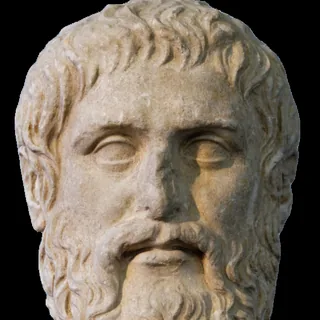
Portrait (cropped): Marie-Lan Nguyen, CC BY 2.5, Wikimedia Commons

Last updated: