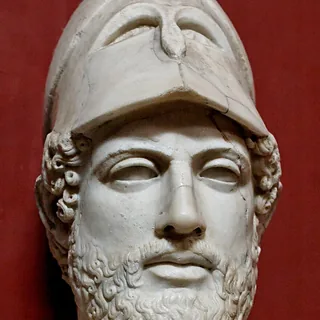
Key Facts
- c. 495 BC: born in the deme of Cholargos, in Attica
- 461 BC: ostracism of Cimon; Pericles becomes leader of the democrats
- 451 BC: law restricting citizenship to children of two Athenian parents
- 447 BC: construction of the Parthenon begins
- 431 BC: outbreak of the Peloponnesian War; funeral oration
- 430 BC: plague of Athens and removal from office
- 429 BC: dies of the plague
Biography
Pericles (c. 495-429 BC), an Athenian statesman, orator and general, dominated the political life of Athens for some thirty years, at the height of its power. His name remains linked to the deepening of Athenian democracy, to the building of the Parthenon and to the city's golden age, often called the “Age of Pericles”. The historian Thucydides describes him as the first citizen of Athens.
Born in about 495 BC in the deme of Cholargos, in Attica, he was the son of Xanthippus, victor over the Persians at Mycale, and of Agariste, of the powerful Alcmaeonid family. He received a careful education from the musician Damon and the philosopher Anaxagoras, with whom he remained close all his life. He joined the democratic camp, opposing the aristocrat Cimon, who favoured an understanding with Sparta.
With Ephialtes, he stripped the Areopagus, the old aristocratic council, of most of its powers, and in 461 BC secured the ostracism of Cimon. Having become the leader of the democratic party after the murder of Ephialtes, he introduced payment for citizens who sat in the courts, which allowed the poorest to take part in public life. In 451 BC, on the other hand, a law restricted citizenship to children of an Athenian father and mother. Elected general many times, he led the city through persuasion, thanks to his eloquence.
He turned the Delian League, an alliance formed against the Persians, into a genuine Athenian empire and had its treasury moved from Delos to Athens. Part of these funds paid for a vast building programme on the Acropolis, carried out with the sculptor Phidias: the Parthenon, begun in 447 BC, then the Propylaea. He also led military campaigns, notably against Samos, which revolted in 440 BC. His companion, Aspasia of Miletus, renowned for her intelligence, was often the target of his opponents.
When the Peloponnesian War against Sparta broke out in 431 BC, he had the population of Attica take shelter behind the Long Walls and relied on the fleet to raid the enemy's coasts. At the end of the first year of the war he delivered the funeral oration for the fallen soldiers, recorded by Thucydides, which celebrates Athenian democracy. But in 430 BC the plague struck the overcrowded city; Pericles was removed from office and fined, then re-elected the following year. He died of the disease in 429 BC, having lost both his legitimate sons.
Related event
Also worth discovering
Last updated: