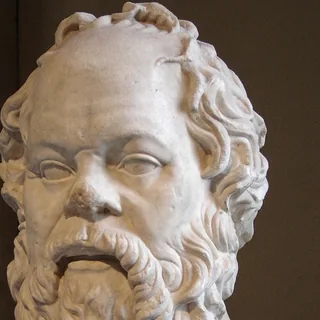
Key Facts
- c. 470 BC: born in Athens
- 432 BC: fights at Potidaea, where he saves Alcibiades
- 423 BC: caricatured by Aristophanes in The Clouds
- 406 BC: opposes the trial of the generals of Arginusae
- 404 BC: disobeys the Thirty Tyrants
- 399 BC: tried for impiety and corrupting the young
- 399 BC: dies by hemlock in Athens
Biography
Socrates (c. 470-399 BC), an Athenian philosopher, is regarded as the father of Western philosophy. He wrote nothing: he is known mainly through the dialogues of his disciple Plato and the writings of Xenophon. Through his questions he led the people he spoke with to recognise their ignorance and to seek the truth. Accused of impiety and of corrupting the young, he was sentenced to death and drank hemlock.
Born around 470 BC in Athens, the son of Sophroniscus, a sculptor or stonemason, and of Phaenarete, a midwife, he grew up in the city of Pericles, then at its height. A citizen soldier, he fought as a hoplite in the Peloponnesian War, notably at Potidaea, where he saved the life of the young Alcibiades, and then at Delium and Amphipolis; his courage and endurance were praised. He married Xanthippe, with whom he had three sons. Poor, known for his ugliness and snub nose, he walked barefoot even in winter.
Socrates spent his days in the agora and the gymnasia questioning his fellow citizens about courage, justice or virtue. His method, made up of irony and questions, showed that those who thought they knew contradicted themselves; he compared it to his mother's art, maieutics, which helps minds “give birth” to ideas. According to Plato, the oracle at Delphi declared him the wisest of men, because he knew that he knew nothing. He took up the maxim “Know thyself”.
He refused to bow to injustice: in 406 BC he alone opposed the collective trial of the generals victorious at Arginusae, and in 404 he disobeyed the Thirty Tyrants when they ordered him to arrest an innocent man. But his ties with Alcibiades and with some of the Thirty made him suspect in the eyes of the restored democracy. The comic poet Aristophanes had already caricatured him in The Clouds in 423 BC.
In 399 BC three citizens accused him of not recognising the gods of the city and of corrupting the young. Before the court he defended himself without trying to move the judges to pity, as reported in Plato's Apology of Socrates, and, found guilty by a narrow majority of the jurors, he was sentenced to death. Out of respect for the laws he refused to escape from prison, then drank hemlock surrounded by his friends, a scene told in the Phaedo. His death made him the model of the sage faithful to his convictions.
Sources: Wikipédia, « Socrate »; Wikipedia, « Socrates »; Stanford Encyclopedia of Philosophy, « Socrates »
Related event
Also worth discovering
Portrait (cropped): Eric Gaba, CC BY-SA 2.5, Wikimedia Commons

Last updated: