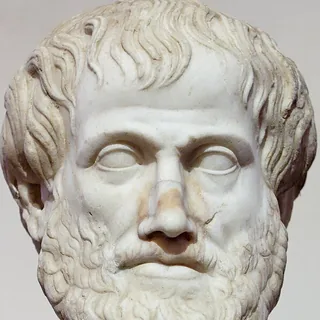
Key Facts
- 384 BC: born at Stagira, in Chalcidice
- c. 367 BC: enters Plato's Academy in Athens
- c. 343 BC: becomes tutor to Alexander the Great
- 335 BC: founds the Lyceum in Athens
- 323 BC: accused of impiety, leaves Athens for Chalcis
- 322 BC: dies at Chalcis, in Euboea
Biography
Aristotle (384-322 BC), a Greek philosopher, pupil of Plato and tutor to Alexander the Great, is one of the most influential thinkers in history. His work, which spans logic, physics, biology, ethics, politics and poetics, dominated learned thought for nearly two thousand years.
Born in 384 BC at Stagira, in Chalcidice, he was the son of Nicomachus, physician to King Amyntas III of Macedon. Orphaned at a young age, he went to Athens at seventeen and entered Plato's Academy; he remained there for some twenty years, until his teacher's death in 348 or 347 BC. He then lived at Assos, in Asia Minor, and on Lesbos, where with Theophrastus he made numerous observations of animals.
Around 343 BC King Philip II of Macedon summoned him to become the tutor of his son Alexander, then thirteen years old. Back in Athens in 335 BC, Aristotle founded his own school there, the Lyceum, whose members were called Peripatetics, after the covered walkway where lessons were held. He gathered a vast library there and directed collective research, such as the collection of the constitutions of one hundred and fifty-eight Greek cities. He taught there for twelve years, while his former pupil conquered the Persian Empire.
Unlike Plato, Aristotle sought truth through the observation of the physical world. He founded formal logic with the theory of the syllogism, classified living beings, defined virtue as a mean in the Nicomachean Ethics and saw man as a “political animal”. His surviving works are mostly lecture notes; the dialogues he wrote for the public are lost. After Alexander's death in 323 BC, accused of impiety, he left Athens for Chalcis, in Euboea, so as, he is said to have remarked, to spare the Athenians from sinning twice against philosophy. He died there the following year.
Rediscovered in the West from the 12th century thanks to translations from Arabic and the commentaries of Averroes, Aristotle became for medieval thinkers such as Thomas Aquinas “the Philosopher” par excellence. His physics was challenged by Galileo and the Scientific Revolution, but his logic, ethics and politics are still studied throughout the world, and his Poetics, devoted to tragedy, inspired the theorists of classical drama.
Sources: Wikipédia, « Aristote »; Wikipedia, « Aristotle »; Encyclopédie Larousse, « Aristote »
Related event
Also worth discovering
Last updated: