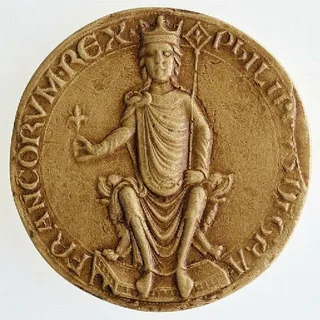
Key Facts
- Is crowned at Reims on 1 November 1179, during the lifetime of his father Louis VII
- Becomes sole King of France on 18 September 1180
- Takes part in the Third Crusade and the siege of Acre in 1191
- Captures Château Gaillard and Rouen and completes the conquest of Normandy in 1204
- Wins the Battle of Bouvines on 27 July 1214
- Dies at Mantes on 14 July 1223
Biography
Philip II Augustus (1165-1223), King of France from 1180 to 1223, was one of the great architects of Capetian power. By taking Normandy and much of their land from the kings of England, and then winning the Battle of Bouvines in 1214, he made the king the most powerful lord in the realm. He is often described as the first ruler to style himself “King of France” rather than “King of the Franks”.
Born on 21 August 1165, he was the son of King Louis VII and Adela of Champagne. Crowned at Reims on 1 November 1179, while his father was still alive but ailing, he became sole king on 18 September 1180, at the age of fifteen. That same year he married Isabella of Hainault. In 1182 he expelled the Jews from the royal domain and confiscated their property, a measure he later reversed.
In July 1190 he set out from Vézelay on the Third Crusade alongside Richard the Lionheart, King of England. He reached Acre in April 1191 and took part in the siege of the city, then returned to France the same year, ill and at odds with Richard. Their rivalry lasted until Richard's death in 1199. His private life also caused a serious crisis: having married Ingeborg of Denmark in 1193, he immediately tried to repudiate her and married Agnes of Merania, which led the pope to place the kingdom under an interdict in 1200.
It was against John Lackland, Richard's brother and successor, that Philip won his greatest successes. In 1204 he took the fortress of Château Gaillard, then Rouen, and completed the conquest of Normandy, before seizing other Plantagenet lands in western France. On 27 July 1214, at Bouvines, he defeated the coalition formed by John and the Emperor Otto IV. The victory ended Plantagenet dominance in the west of the kingdom and confirmed the king's authority.
Philip also strengthened royal government, entrusting the domain to bailiffs and provosts, and transformed Paris, which he surrounded with a wall and endowed with the fortress of the Louvre. The chronicler Rigord called him “Augustus”, both for his enlargement of the royal domain and because he was born in August. He died at Mantes on 14 July 1223 and was buried at Saint-Denis; his son Louis VIII succeeded him.
Sources: Wikipédia, « Philippe II Auguste »; Wikipedia, « Philip II of France »
Kings of France (1180-1223)
Related event
Also worth discovering
Last updated: