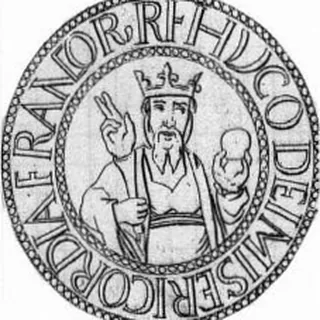
Key Facts
- Inherits the estates of his father, Hugh the Great, in 956
- Bears the title of Duke of the Franks from 960
- Is elected king at Senlis in 987, after the death of the last Carolingian, Louis V
- Has his son Robert crowned on 25 December 987 to secure the succession
- Secures the capture of his rival Charles of Lorraine in 991
- Dies on 24 October 996 and is buried at Saint-Denis
Biography
Hugh Capet (c. 940-996) was the founder of the Capetian dynasty. Duke of the Franks, he was elected king in 987 after the death of the last Carolingian ruler, Louis V. His descendants reigned over France without interruption until the Revolution, and again from the Restoration until 1848, which makes his election one of the landmark dates in French history.
Born around 940, he was the son of Hugh the Great, Duke of the Franks, and of Hedwig of Saxony. Through his paternal grandmother, Beatrice of Vermandois, he was also descended from the Carolingians. He belonged to the Robertian family, one of the most powerful in the kingdom, which had already given the Franks two kings in the previous century, Odo and Robert I. On his father's death in 956 he inherited his vast estates, and from 960 he bore the title of Duke of the Franks, under the protection of his uncles, the Ottonian rulers of Germany.
On 22 May 987 the young king Louis V died after a fall from his horse, leaving no children. The Archbishop of Reims, Adalbero, backed by the scholar Gerbert of Aurillac, the future Pope Sylvester II, gathered the great lords of the kingdom at Senlis and had the last Carolingian claimant, Charles of Lorraine, set aside in favour of Hugh. Once elected, Hugh was crowned in the course of 987; the place of the ceremony, Noyon or Reims, is still debated. On Christmas Day 987 he had his son Robert crowned as well, associating him with the throne to secure the succession.
His authority nevertheless remained limited: the royal domain was small, and great vassals such as the dukes of Normandy and the counts of Anjou were richer than he was. Hugh relied on the Church and on alliances with these princes. Charles of Lorraine, who disputed the crown, seized Laon and held out against the king for several years, until he was handed over in 991 through the treachery of the Bishop of Laon, also called Adalbero; he died a prisoner in Orléans.
Hugh Capet died on 24 October 996 and was buried in the Basilica of Saint-Denis. His son Robert II succeeded him without difficulty. His byname, whose meaning remains uncertain, eventually came to designate his whole line: the direct Capetians reigned until 1328, followed by their cadet branches, the Valois, the Bourbons and the Orléans. His reign is known above all through the chronicle of Richer of Reims, whose account partly reflects the views of his clerical patrons.
Sources: Wikipédia, « Hugues Capet »; Wikipedia, « Hugh Capet »
Kings of France (987-996)
Also worth discovering
Portrait (cropped): LeThéodorus, CC BY-SA 3.0, Wikimedia Commons

Last updated: