Key Facts
- Marries Joan I of Navarre in 1284 and becomes King of Navarre
- Succeeds his father Philip III as King of France in 1285
- Is defeated at Courtrai in 1302, then beats the Flemish at Mons-en-Pévèle in 1304
- Has Pope Boniface VIII seized at Anagni in 1303
- Expels the Jews from the kingdom in 1306
- Has the Templars arrested in October 1307
- Dies at Fontainebleau on 29 November 1314
Biography
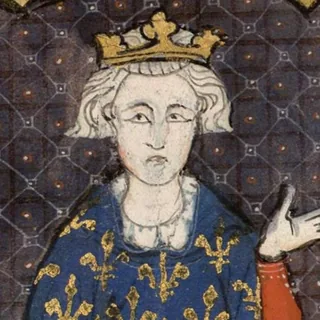
Philip IV (1268-1314), known as Philip the Fair, King of France from 1285 to 1314, was one of the rulers who did most to strengthen the monarchical state in the Middle Ages. Surrounded by lawyers, he defied Pope Boniface VIII, had the Templars arrested and resorted to every expedient to pay for his wars. His effective and ruthless reign earned him the nickname of the “Iron King”.
Born in 1268 at the Château de Fontainebleau, he was the son of Philip III the Bold and Isabella of Aragon, and the grandson of Saint Louis. He received a careful education and learned Latin. In 1284 he married Joan I, Queen of Navarre and Countess of Champagne, which also made him King of Navarre. He succeeded his father in 1285, at the age of seventeen.
To govern, Philip relied on men trained in law, such as Guillaume de Nogaret and Enguerrand de Marigny, who expanded the royal administration and asserted the king's authority over the great lords and the clergy. He summoned assemblies representing the three estates of the realm, forerunners of the Estates General. He fought the King of England in Guyenne, a conflict ended by the Treaty of Paris of 1303, and Flanders: defeated at Courtrai in 1302, in the Battle of the Golden Spurs, he won at Mons-en-Pévèle in 1304 and gained Lille and Douai. Lyon was also attached to the kingdom.
His wars were costly. The king repeatedly altered the coinage, which caused discontent, turned on the Italian bankers and expelled the Jews from the kingdom in 1306, confiscating their property. His determination to tax the clergy set him against Pope Boniface VIII: in 1303 men led by Nogaret seized the pontiff at Anagni, and he died the same year. The popes who followed soon settled in Avignon, under French influence. In October 1307 Philip had the Templars arrested throughout the kingdom, then obtained from the pope the suppression of their order; the Grand Master, Jacques de Molay, was burned at the stake in 1314.
That same year the Tour de Nesle affair, the adultery of two of his daughters-in-law, shook the royal family. Philip died at Fontainebleau on 29 November 1314, after a hunting accident followed by a stroke. His three sons, Louis X, Philip V and Charles IV, reigned in turn, but none left a male heir: in 1328 the crown passed to the Valois, a disputed succession that paved the way for the Hundred Years' War.
Sources: Wikipédia, « Philippe IV le Bel »; Wikipedia, « Philip IV of France »
Kings of France (1285-1314)
Also worth discovering
Last updated: