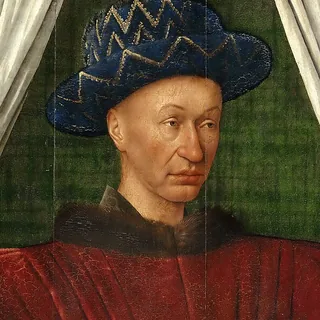
Key Facts
- Becomes dauphin in 1417, after the death of his elder brothers
- Is disinherited by the Treaty of Troyes in 1420
- Is crowned at Reims on 17 July 1429, thanks to Joan of Arc
- Is reconciled with Burgundy by the Treaty of Arras in 1435 and retakes Paris in 1436
- Creates the compagnies d'ordonnance, the first standing army, in 1445
- Ends the Hundred Years' War with the victory at Castillon in 1453
- Dies at Mehun-sur-Yèvre on 22 July 1461
Biography
Charles VII (1403-1461), King of France from 1422 to 1461, inherited a kingdom partly occupied by the English and torn apart by civil war. Thanks to Joan of Arc, and then to the reorganisation of his army, he won back the country and brought the Hundred Years' War to an end, which earned him the epithet “the Victorious”.
Born in Paris on 22 February 1403, he was the fifth son of King Charles VI, who suffered from bouts of madness, and of Isabeau of Bavaria. The death of his elder brothers made him dauphin in 1417. He became the leader of the Armagnac party, which was fighting the Burgundians for control of the government. When the Burgundians seized Paris in 1418, he set up his court at Bourges. In 1419 John the Fearless, Duke of Burgundy, was murdered at Montereau during a meeting with the dauphin; his son, Philip the Good, then allied himself with the English.
The Treaty of Troyes, in 1420, disinherited Charles in favour of Henry V of England. When Henry V and Charles VI died within weeks of each other in 1422, the dauphin proclaimed himself king, but he controlled little more than the lands south of the Loire, and his opponents mockingly called him the “King of Bourges”. In 1429 Joan of Arc raised the siege of Orléans and led him to Reims, where he was crowned on 17 July. Captured the following year, she was condemned and burned by the English side without the king intervening; in 1456 he secured the annulment of her conviction.
Charles VII then consolidated his power. The Treaty of Arras, in 1435, reconciled him with Burgundy, and Paris was retaken in 1436. With the Pragmatic Sanction of Bourges, in 1438, he asserted royal authority over the Church in France, and in 1440 he crushed the revolt of the great lords known as the Praguerie. In 1445 he created the compagnies d'ordonnance, the kingdom's first standing army, and developed its artillery. The victories of Formigny, in 1450, and Castillon, in 1453, drove the English out of France, except for Calais.
His last years were darkened by his conflict with his son, the future Louis XI, who fled to the Burgundian court in 1456. Married to Marie of Anjou, with whom he had fourteen children, the king also had a favourite, Agnès Sorel. Weakened by an abscess in his mouth that prevented him from eating, he died at Mehun-sur-Yèvre on 22 July 1461 and was succeeded by Louis XI.
Sources: Wikipédia, « Charles VII (roi de France) »; Wikipedia, « Charles VII of France »
Kings of France (1422-1461)
Related event
Also worth discovering
Last updated: