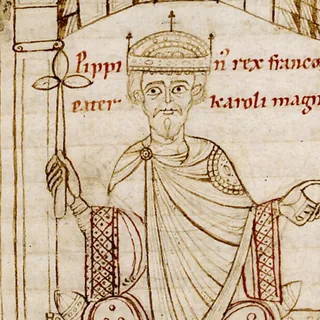
Key Facts
- Becomes mayor of the palace with his brother Carloman on the death of Charles Martel in 741
- Is left sole master of the kingdom after Carloman's retirement in 747
- Deposes Childeric III and is elected King of the Franks at Soissons in 751
- Is anointed a second time by Pope Stephen II at Saint-Denis in 754
- Gives the pope the lands taken from the Lombards, the origin of the Papal States
- Takes Narbonne from the Arabs in 759
- Dies at Saint-Denis on 24 September 768
Biography
Pepin the Short (c. 714-768) was the first king of the Franks from the Carolingian dynasty. Mayor of the palace under the last Merovingians, he deposed Childeric III in 751 and had himself recognised as king with the pope's support. His alliance with the papacy, sealed by a second anointing in 754, gave rise to the Papal States and paved the way for the empire of his son Charlemagne.
Born around 714, he was the younger son of Charles Martel, the mayor of the palace who then governed the kingdom in the name of powerless Merovingian kings. He was brought up by the monks of the Abbey of Saint-Denis, who gave him a thorough religious education. On his father's death in 741 he shared this office with his brother Carloman. The two brothers put down revolts in Aquitaine, Bavaria and Alemannia, and undertook the reform of the Church with Bishop Boniface. In 747 Carloman withdrew from public life, leaving Pepin sole master of the kingdom.
With the agreement of Pope Zachary, Pepin deposed the last Merovingian king, Childeric III, in 751 and had himself elected king at Soissons. He was anointed by the bishops, a new gesture that gave his dynasty religious legitimacy. In 754 Pope Stephen II, who had come to seek his help against the Lombards threatening Rome, anointed him again at Saint-Denis, together with his two sons, and gave him the title of Patrician of the Romans.
In return, Pepin campaigned in Italy against the Lombards from 754 to 756 and handed the conquered territories over to the pope: this donation was the origin of the Papal States, which survived until the 19th century. He then drove the Arabs out of Septimania, taking Narbonne in 759, and for years fought Waiofar, Duke of Aquitaine, until 768. He also campaigned against the Saxons and the Bavarians, whose full subjugation was left to his successors. At home he reformed the coinage and introduced the tithe for the benefit of the Church.
He died at Saint-Denis on 24 September 768 and was buried there. In keeping with Frankish custom, he divided his kingdom between his two sons, Charles, the future Charlemagne, and Carloman. Charlemagne, crowned emperor in 800, would carry on his work. The dynasty Pepin founded, called Carolingian after his son, ruled the western Franks until 987. By making anointing a foundation of kingship, Pepin bound the Frankish, and later French, monarchy closely to the Church.
Sources: Wikipédia, « Pépin le Bref »; Wikipedia, « Pepin the Short »
Kings of France (751-768)
Related event
Also worth discovering
Last updated: