Key Facts
- Becomes in 1349 the first heir to the throne to bear the title of dauphin
- Governs the kingdom after his father's capture at Poitiers in 1356
- Faces Étienne Marcel's Paris revolt and the Jacquerie in 1358
- Is crowned king at Reims on 19 May 1364
- Reopens the war against the English in 1369 and recovers most of the lost lands
- Assembles at the Louvre the royal library, forerunner of the Bibliothèque nationale de France
- Dies at the Château de Beauté-sur-Marne on 16 September 1380
Biography
Charles V the Wise (1338-1380), King of France from 1364 to 1380, restored a kingdom shaken by the first defeats of the Hundred Years' War. Prudent and cultivated, he won back from the English most of the lands that had been lost, restored the royal finances and assembled at the Louvre a library that is the forerunner of the Bibliothèque nationale de France.
Born at the Château de Vincennes on 21 January 1338, he was the son of King John II the Good and would be the third king of the Valois dynasty. Intelligent but physically frail, in 1349 he became the first heir to the throne to bear the title of dauphin, after the Crown acquired the Dauphiné of Viennois. In 1350 he married Joan of Bourbon.
In 1356 his father was taken prisoner by the English at the Battle of Poitiers. As lieutenant of the kingdom, the young Charles then faced a grave crisis: the King of Navarre, Charles the Bad, and the provost of the merchants of Paris, Étienne Marcel, sought to place the monarchy under the control of the Estates General, which the Great Ordinance of 1357 partly enshrined. In 1358 Paris rose in revolt and the peasant uprising of the Jacquerie swept the countryside, until Étienne Marcel was killed on 31 July. To secure his father's release, Charles accepted the Treaty of Brétigny in 1360, which ceded much of the south-west of the kingdom to England and set a very heavy ransom.
On becoming king at the death of John II, he was crowned at Reims on 19 May 1364. He restored royal authority, kept the currency stable and created lasting taxes to pay for a standing army. With his brothers and commanders such as Bertrand du Guesclin, he rid the kingdom of the Great Companies of mercenaries and isolated England diplomatically. War resumed in 1369: by avoiding pitched battles, the French reconquered most of the ceded territories, except Calais and Gascony.
Charles V built or rebuilt the Louvre, the Bastille and the Château de Vincennes. He gave the Duchy of Burgundy to his brother Philip, founder of the Valois-Burgundy line. In 1378 he backed Pope Clement VII against Urban VI, helping to bring about the Western Schism. He died on 16 September 1380 at the Château de Beauté-sur-Marne and was succeeded by his son Charles VI, under whose reign many of his conquests would be lost.
Sources: Wikipédia, « Charles V (roi de France) »; Wikipedia, « Charles V of France »
Kings of France (1364-1380)
Related event
Also worth discovering
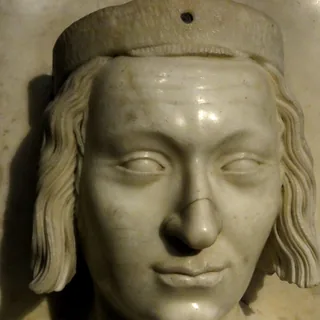
Portrait (cropped): P.poschadel, CC BY-SA 3.0, Wikimedia Commons

Last updated: