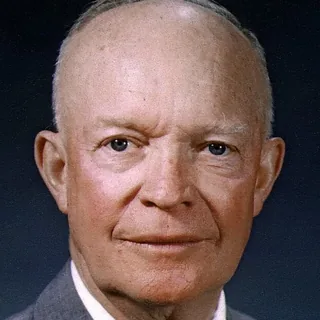
Key Facts
- 14 October 1890: born in Denison (Texas)
- November 1942: commands Operation Torch in North Africa
- 6 June 1944: Normandy landings under his command
- 1951: first Supreme Allied Commander Europe of NATO
- 20 January 1953: inaugurated as President of the United States
- 1957: sends the army to Little Rock to enforce school desegregation
- 28 March 1969: dies in Washington
Biography
Dwight D. Eisenhower (1890-1969), the 34th President of the United States from 1953 to 1961, was first the general who commanded the Allied forces in the Normandy landings on 6 June 1944. A Republican president at the height of the Cold War, he ended the Korean War, launched the Interstate Highway System and created NASA, before warning, as he left office, against the weight of the “military-industrial complex”.
Born on 14 October 1890 in Denison, Texas, he grew up in Abilene, Kansas, in a family of modest means. A graduate of the West Point military academy in 1915, he spent the First World War in the United States training tank crews, without seeing combat. Between the wars he held staff posts and served under General Douglas MacArthur, notably in the Philippines from 1935 to 1939.
After the United States entered the war, his rise was meteoric. In November 1942 he commanded Operation Torch, the Allied landings in North Africa, then directed operations in the Mediterranean. Appointed Supreme Commander of the Allied Expeditionary Force, he led the Normandy landings on 6 June 1944 and the campaign that ended in Germany's surrender. In December 1944 he received the fifth star of General of the Army. After the war he was Army Chief of Staff and President of Columbia University, then, in 1951, the first Supreme Allied Commander Europe of NATO.
As the Republican candidate, he won the 1952 presidential election against the Democrat Adlai Stevenson, whom he beat again in 1956, with Richard Nixon as his vice president. Inaugurated on 20 January 1953, he secured in July the armistice that ended the fighting in Korea. His defence policy, the “New Look”, relied on nuclear deterrence. In 1956 he launched the construction of the Interstate Highway System. In 1957 he sent the army to Little Rock, Arkansas, to enforce the desegregation of a high school, and signed the first civil rights law since Reconstruction. The launch of the Soviet satellite Sputnik led to the creation of NASA in 1958.
In May 1960 the downing of a U-2 spy plane over the USSR wrecked a summit with Nikita Khrushchev. In his farewell address in January 1961, Eisenhower warned his fellow citizens against the undue influence of the “military-industrial complex”. Retired from political life, he died in Washington on 28 March 1969, aged seventy-eight, and was buried in Abilene. Historians generally rank him among the best American presidents.
Sources: Wikipédia, « Dwight D. Eisenhower »; Wikipedia, « Dwight D. Eisenhower »
US Presidents (1953-1961)
Related event
Also worth discovering
Last updated: