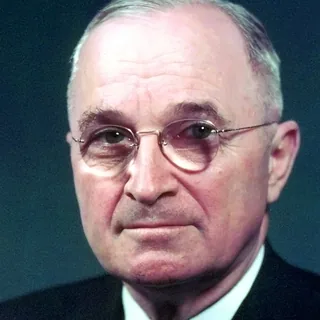
Key Facts
- 8 May 1884: born in Lamar, Missouri
- 1934: elected senator for Missouri
- 12 April 1945: becomes president on Franklin Roosevelt's death
- 6 and 9 August 1945: atomic bombings of Hiroshima and Nagasaki
- March 1947: Truman Doctrine of containing communism
- November 1948: re-elected against Thomas Dewey
- 26 December 1972: dies in Kansas City
Biography
Harry S. Truman (1884-1972), 33rd President of the United States from 1945 to 1953, succeeded Franklin Roosevelt in the last months of the Second World War. He ordered the atomic bombings of Hiroshima and Nagasaki and then committed his country to the Cold War: the doctrine of containing communism, the Marshall Plan, the founding of NATO and the Korean War marked his presidency.
Born on 8 May 1884 in Lamar, Missouri, the son of a farmer and livestock dealer, he could not afford to go to college and worked in a bank and then on the family farm. During the First World War he commanded an artillery battery in France. After the failure of the haberdashery he opened in Kansas City, he entered politics with the backing of Tom Pendergast's Democratic machine and in 1922 became a judge, in other words an administrator, of Jackson County.
Elected senator for Missouri in 1934, he supported the New Deal and made his name during the war at the head of a committee that tracked down waste in military spending. Chosen as Roosevelt's running mate in 1944, he became vice-president in January 1945. When the president died on 12 April 1945, he succeeded him without having been told about the atomic bomb project. He was in office for Germany's surrender on 8 May, his birthday, took part in the Potsdam Conference in July and decided to use the new weapon against Japan: Hiroshima was destroyed on 6 August 1945, Nagasaki on the 9th, and Japan surrendered.
Facing the Soviet Union, Truman announced in March 1947 the doctrine that bears his name: the United States would support free peoples threatened by communism. The Marshall Plan helped rebuild Western Europe, the airlift saved West Berlin from the Soviet blockade, and NATO was founded in 1949. He recognised Israel as soon as it was proclaimed in May 1948 and the same year ordered an end to segregation in the armed forces. Expected to lose, he was re-elected in November 1948 against the Republican Thomas Dewey, so unexpectedly that one newspaper wrongly announced his opponent's victory.
In June 1950 he sent American troops to defend South Korea, which had been invaded by the North. General MacArthur, who wanted to extend the war to China, was relieved of his command in April 1951, a decision that made Truman very unpopular. Declining to run again, he left the White House in January 1953 and retired to Independence, Missouri, where he founded his presidential library. He died in Kansas City on 26 December 1972. A sign on his desk summed up his view of power: “The buck stops here”.
Sources: Wikipédia, « Harry S. Truman »; Wikipedia, « Harry S. Truman »
US Presidents (1945-1953)
Related event
Also worth discovering
Last updated: