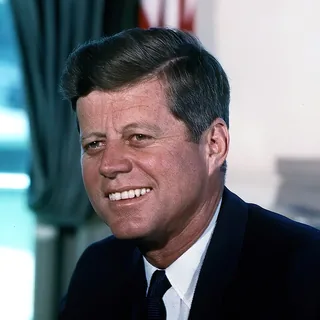
John F. Kennedy
Key Facts
- Born on 29 May 1917 in Brookline, Massachusetts
- Commanded the torpedo boat PT-109, cut in two by a Japanese destroyer in August 1943
- Elected in 1960 at forty-three, the youngest president ever elected and the first Catholic president of the United States
- Set the goal on 25 May 1961 of landing a man on the Moon before the end of the decade
- Secured the withdrawal of Soviet missiles from Cuba in October 1962
- Declared “Ich bin ein Berliner” in West Berlin on 26 June 1963
- Assassinated in Dallas on 22 November 1963
Biography
John Fitzgerald Kennedy (1917-1963), the thirty-fifth President of the United States, is the youngest person ever elected to the office, at forty-three, and was the first Catholic to enter the White House. His presidency, cut short by his assassination in Dallas on 22 November 1963, was shaped by the tensions of the Cold War, including the Cuban Missile Crisis, by the race to the Moon and by the first steps towards a major civil rights law.
Born on 29 May 1917 in Brookline, near Boston, the second of the nine children of Joseph Kennedy, a businessman and later American Ambassador in London, he graduated from Harvard in 1940; his thesis on Britain's unpreparedness in the face of Nazi Germany was published that same year as “Why England Slept”. A naval officer in the Second World War, he commanded the torpedo boat PT-109, which was cut in two by a Japanese destroyer on the night of 1 to 2 August 1943, and helped the survivors of his crew to reach an island. Elected to the House of Representatives in 1946 and to the Senate in 1952, he married Jacqueline Bouvier on 12 September 1953 and won the Pulitzer Prize in 1957 for his book “Profiles in Courage”.
On 8 November 1960 he narrowly defeated Vice-President Richard Nixon, after the first televised debates in an American presidential campaign. In his inaugural address on 20 January 1961 he declared: “Ask not what your country can do for you, ask what you can do for your country.” His early months were marred by the failed landing of Cuban exiles at the Bay of Pigs in April 1961, but he created the Peace Corps and, on 25 May 1961, set the goal of landing a man on the Moon before the end of the decade. In October 1962 the discovery of Soviet nuclear missiles in Cuba brought the world to the brink of war; he imposed a naval blockade on the island and persuaded Nikita Khrushchev to withdraw the missiles.
On 11 June 1963 he announced a civil rights bill intended to end racial segregation. On 26 June, in West Berlin, cut off from the East by the Wall since 1961, he proclaimed “Ich bin ein Berliner”. That same year the United States signed a treaty with the USSR and the United Kingdom banning nuclear tests in the atmosphere, in outer space and under water, while in Vietnam Kennedy sharply increased the number of American military advisers. On 22 November 1963 he was shot dead in Dallas, Texas, while being driven through the city in an open-top car; Lee Harvey Oswald, arrested the same day, was shot dead two days later by Jack Ruby. In 1964 the Warren Commission concluded that Oswald had acted alone, a finding that numerous conspiracy theories have disputed ever since.
Vice-President Lyndon B. Johnson, sworn in that same day, secured the passage of the Civil Rights Act in 1964, and in July 1969 the Apollo 11 astronauts landed on the Moon, as Kennedy had wished. Buried in Arlington National Cemetery, he remains one of the most popular presidents among Americans, the embodiment of a new generation in power, even though historians take a more nuanced view of a record left unfinished.