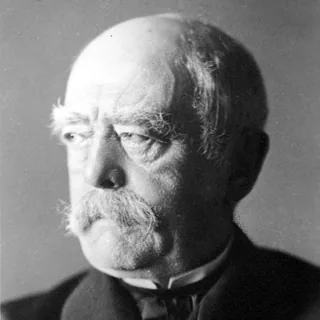
Otto von Bismarck
Key Facts
- Born on 1 April 1815 at Schönhausen, Prussia, into a Junker family
- Appointed Minister President of Prussia on 23 September 1862
- Won the wars against Denmark (1864), Austria (1866) and France (1870-1871)
- Had the German Empire proclaimed at Versailles on 18 January 1871
- Chancellor of the German Empire from 1871 to 1890
- Introduced Germany's first social insurance schemes, from 1883 to 1889
- Died at Friedrichsruh on 30 July 1898
Biography
Otto von Bismarck (1815-1898) was the architect of German unification. Minister President of Prussia from 1862, he founded the German Empire in 1871 after three victorious wars, then led it as chancellor until 1890, which earned him the nickname of the “Iron Chancellor”.
Born on 1 April 1815 at Schönhausen, in the Altmark region of Prussia, into a family of landed gentry, the Junkers, he studied law at Göttingen and then in Berlin. A conservative member of the Prussian United Diet in 1847, he opposed the revolution of 1848. From 1851 he represented Prussia at the Diet of the German Confederation in Frankfurt, then served as ambassador in St Petersburg in 1859 and in Paris in 1862. On 23 September 1862 King William I, in conflict with Parliament over army reform, called on him to head the government; a week later he declared that the great questions of the day would be decided “by iron and blood”.
He achieved unification through war. In 1864 Prussia and Austria took the duchies of Schleswig and Holstein from Denmark; in 1866 Prussia crushed Austria at Königgrätz, on 3 July, and the following year formed the North German Confederation, with Bismarck as its chancellor. In July 1870 the Ems Dispatch, which he had deliberately made offensive, provoked the France of Napoleon III into declaring war; the French defeat at Sedan on 1 September paved the way for the proclamation of the German Empire on 18 January 1871 in the Hall of Mirrors at the Palace of Versailles. William I became German Emperor, Bismarck Imperial Chancellor, and France had to cede Alsace and part of Lorraine.
As chancellor he waged the Kulturkampf against the Catholic Church in the 1870s, then turned on the socialists, who were banned by the laws of 1878. To draw workers away from social democracy, he had pioneering social insurance passed: health insurance in 1883, accident insurance in 1884, and old-age and disability insurance in 1889. In foreign policy he sought to isolate France and preserve peace in Europe: he chaired the Congress of Berlin in 1878 and the Berlin Conference on Africa in 1884-1885, concluded the Triple Alliance with Austria-Hungary and Italy in 1882, and then the Reinsurance Treaty with Russia in 1887.
The new emperor, Wilhelm II, who came to the throne in 1888 determined to rule in person, forced him to resign in March 1890. Retiring to his estate at Friedrichsruh, near Hamburg, Bismarck criticised the policies of his successor and wrote his memoirs; he died there on 30 July 1898, aged eighty-three. The founder of a state that became the leading power on the Continent, he also left behind an authoritarian regime and a lasting rivalry with France, and the Reinsurance Treaty was not renewed after his departure.