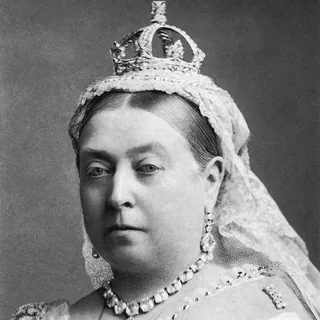
Queen Victoria
Key Facts
- Born on 24 May 1819 at Kensington Palace, London
- Became Queen of the United Kingdom on 20 June 1837, aged eighteen
- Married Prince Albert of Saxe-Coburg and Gotha on 10 February 1840
- Took the title of Empress of India in 1876, proclaimed in Delhi on 1 January 1877
- Celebrated her Golden (1887) and Diamond (1897) Jubilees
- Died on 22 January 1901 at Osborne House, after a reign of more than sixty-three years
Biography
Queen Victoria (1819-1901) reigned over the United Kingdom from 1837 until her death, a span of more than sixty-three years. Her name stands for a whole age, the Victorian era, marked by the Industrial Revolution, the expansion of the British Empire and a stern public morality.
Born on 24 May 1819 at Kensington Palace in London, she was the only child of Prince Edward, Duke of Kent, fourth son of King George III, and Princess Victoria of Saxe-Coburg-Saalfeld. Her father died in January 1820, and she grew up under her mother's close supervision. As her uncles had left no surviving legitimate children, she succeeded William IV on 20 June 1837, aged eighteen, and was crowned in Westminster Abbey on 28 June 1838. Because Salic law barred women from the throne of Hanover, the union between the British Crown and Hanover, which had lasted since 1714, came to an end.
On 10 February 1840 she married her first cousin, Prince Albert of Saxe-Coburg and Gotha, with whom she had nine children. An influential adviser, Albert was the driving force behind the Great Exhibition of 1851 at the Crystal Palace, a showcase of British industrial power. During her reign the United Kingdom dominated world trade, the political role of the Crown gave way to that of Parliament, and the Queen dealt with prime ministers as different as Benjamin Disraeli, her favourite, and William Gladstone. In 1876 the Royal Titles Act gave her the title of Empress of India, proclaimed in Delhi on 1 January 1877.
The death of Albert, carried off by typhoid fever on 14 December 1861, plunged her into a mourning from which she never fully emerged: dressed in black and secluded at Windsor, Osborne or Balmoral, she was rarely seen in public, which for a time fed republican sentiment. She regained popular favour in her final decades, crowned by the Golden Jubilee of 1887 and the Diamond Jubilee of 1897. Her children and grandchildren married into the reigning houses of the Continent, earning her the nickname “the grandmother of Europe”: the German Emperor Wilhelm II and the Tsarina Alexandra were among her grandchildren. She also survived several assassination attempts.
Victoria died on 22 January 1901 at Osborne House on the Isle of Wight, aged eighty-one, and was laid to rest beside Albert in the Royal Mausoleum at Frogmore, Windsor; her son Edward VII succeeded her. Her reign of sixty-three years and seven months remained the longest in British history until 9 September 2015, when Elizabeth II surpassed it. Cities, regions and natural landmarks bear her name around the world, from the Australian state of Victoria to the Victoria Falls, between Zambia and Zimbabwe.