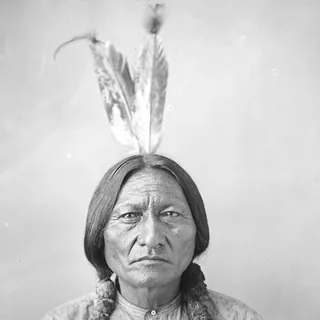
Key Facts
- c. 1831: born near the Grand River, in present-day South Dakota
- 1868: refuses to sign the Treaty of Fort Laramie
- 25 June 1876: victory at the Little Bighorn over Custer
- 1877: takes refuge in Canada
- 19 July 1881: surrenders at Fort Buford
- 1885: joins Buffalo Bill's Wild West
- 15 December 1890: killed on the Standing Rock reservation
Biography
Sitting Bull (c. 1831-1890), a chief and holy man of the Hunkpapa Lakota Sioux, is one of the great figures of Native American resistance to the conquest of the American West. The inspiration behind the victory at the Little Bighorn over Lieutenant Colonel Custer's detachment in 1876, he long refused to live on a reservation. He was killed in 1890 by the Indian police sent to arrest him, two weeks before the Wounded Knee Massacre.
Born around 1831 near the Grand River, in present-day South Dakota, he was given the name Tatanka Iyotake, “Buffalo Bull Who Sits Down”. A renowned young warrior, he distinguished himself in battles against the Crow and other rival peoples, and then, from the 1860s, against the United States Army, which protected the advance of settlers and gold seekers. He was also a respected spiritual leader whose visions guided his people.
He refused to sign the Treaty of Fort Laramie of 1868, under which other chiefs agreed to live on a great reservation, and went on hunting buffalo with the bands that remained free. But after gold was discovered in 1874 in the Black Hills, sacred land of the Lakota, the government ordered the Sioux to go to the reservations and sent the army against those who refused.
In early June 1876, during a Sun Dance, Sitting Bull had a vision of soldiers falling from the sky into the camp. On 25 June, on the banks of the Little Bighorn in Montana, the Lakota and Cheyenne warriors, led among others by Crazy Horse, wiped out George Custer's detachment: Custer and more than two hundred of his men were killed. Hunted by the army, Sitting Bull took refuge in Canada in 1877, but hunger drove his band back, and he surrendered at Fort Buford on 19 July 1881.
A prisoner for two years at Fort Randall, he was then settled on the Standing Rock reservation. In 1885 he spent four months with Buffalo Bill's Wild West show and became friends with the sharpshooter Annie Oakley. In 1889 he vainly opposed the cession of nearly half of the Great Sioux Reservation. In 1890 the authorities feared he would support the religious movement of the Ghost Dance. On 15 December Lakota policemen sent to arrest him shot him dead outside his cabin. He has become a symbol of the dignity and resistance of Indigenous peoples.
Sources: Wikipédia, « Sitting Bull »; Wikipedia, « Sitting Bull »; Encyclopædia Britannica, « Sitting Bull »
Related event
Also worth discovering
Last updated: