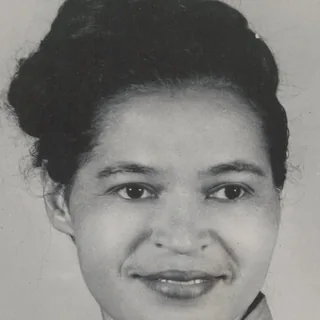
Key Facts
- 4 February 1913: born in Tuskegee, Alabama
- 1932: marries Raymond Parks
- 1943: secretary of the Montgomery branch of the NAACP
- 1 December 1955: refuses to give up her seat on a Montgomery bus
- November 1956: the Supreme Court confirms the end of bus segregation
- 1999: Congressional Gold Medal
- 24 October 2005: dies in Detroit
Biography
Rosa Parks (1913-2005), an African American activist, became the symbol of the civil rights movement in the United States when, on 1 December 1955 in Montgomery, Alabama, she refused to give up her seat on a bus to a white passenger. Her arrest sparked a boycott of the city's buses that lasted more than a year and brought Martin Luther King to prominence. Congress called her “the first lady of civil rights” and “the mother of the freedom movement”.
Born Rosa Louise McCauley on 4 February 1913 in Tuskegee, Alabama, she grew up on a farm near Montgomery, in a South where segregation laws, known as Jim Crow laws, separated Black and white people in schools, transport and public places. In 1932 she married Raymond Parks, a barber active in the defence of Black rights, and she earned her high school diploma in 1933, at a time when few African Americans managed to do so.
In 1943 she became secretary of the Montgomery branch of the NAACP, the leading organisation defending Black rights, and investigated in particular cases of violence against Black women. She also tried several times to register to vote, which she was refused until 1945. In the summer of 1955 she attended a course on desegregation at the Highlander Folk School in Tennessee, a training centre for activists.
On 1 December 1955, while working as a seamstress in a department store, she was going home from work by bus when the driver ordered her to give up her seat to a white man. She refused, was arrested and fined. She was not the first to refuse: in March 1955 a fifteen-year-old schoolgirl, Claudette Colvin, had already been arrested for the same reason. On 5 December the Black community of Montgomery began the bus boycott, organised by an association led by the young minister Martin Luther King. It lasted 381 days, until the Supreme Court confirmed in November 1956 that segregation on buses was unconstitutional.
Dismissed from her job and threatened, Rosa Parks moved to Detroit in 1957, where she worked from 1965 to 1988 for Congressman John Conyers and remained an activist, notably against apartheid. She received the Presidential Medal of Freedom in 1996 and the Congressional Gold Medal in 1999. When she died in Detroit on 24 October 2005, she became the first woman to lie in honour in the Rotunda of the Capitol in Washington, where tens of thousands of people filed past her coffin.
Sources: Wikipédia, « Rosa Parks »; Wikipedia, « Rosa Parks »
Related event
Also worth discovering
Last updated: