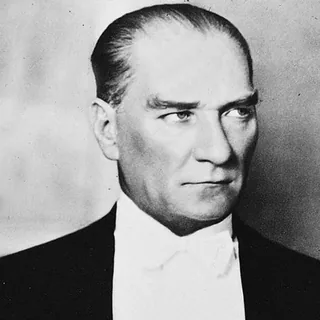
Key Facts
- 1881: born in Salonica, Ottoman Empire
- 1915: distinguishes himself in the Gallipoli campaign
- 19 May 1919: lands at Samsun and launches the War of Independence
- 1 November 1922: abolition of the sultanate
- 29 October 1923: proclamation of the republic, of which he becomes president
- 1928: adoption of the Latin alphabet
- 10 November 1938: dies in Istanbul
Biography
Mustafa Kemal Atatürk (1881-1938), a Turkish officer and statesman, was the founder of the Republic of Turkey, born in 1923 from the ruins of the Ottoman Empire, and its first president until his death. Victorious in the War of Independence, he pushed through a series of reforms that made Turkey a secular state facing towards Europe. He nevertheless ruled with absolute power at the head of a single party.
Born in 1881 in Salonica, then an Ottoman city and now Greek, into a modest family, Mustafa was given the nickname Kemal, “perfection”, by one of his teachers. Trained in military schools, he graduated from the War College in Istanbul in 1905 and drew close to the Young Turks, who wanted a constitutional regime. He fought the Italians in Libya in 1911 and then in the Balkan Wars.
During the First World War he distinguished himself at Gallipoli in 1915, where he helped repel the Allied landings, which made him famous. After the defeat of the empire, which was occupied by the victors, he landed at Samsun on 19 May 1919 and organised national resistance. A Grand National Assembly met in Ankara in April 1920 and rejected the Treaty of Sèvres, which dismembered the country.
As commander-in-chief, Mustafa Kemal drove back the Greek army, notably at the Battle of the Sakarya in 1921, and retook Smyrna in September 1922. The sultanate was abolished on 1 November 1922, and the Treaty of Lausanne recognised the borders of the new Turkey in July 1923; a population exchange then displaced more than a million Greeks from Anatolia and some 400,000 Muslims from Greece. On 29 October 1923 the republic was proclaimed, with Ankara as its capital and Mustafa Kemal as its president; the caliphate was abolished in 1924.
He then launched a cultural revolution: a ban on the fez, a civil code based on the Swiss model that outlawed polygamy, the adoption of the Latin alphabet in 1928 and votes for women in 1934. That year a law made surnames compulsory, and the Assembly gave him the name Atatürk, “father of the Turks”. Secularism was written into the constitution in 1937. Revolts, notably Kurdish ones, were harshly suppressed. He died in Istanbul, at the Dolmabahçe Palace, on 10 November 1938; his mausoleum, the Anıtkabir, overlooks Ankara. His portrait is still everywhere in Turkey, where a law of 1951 punishes insults to his memory.
Sources: Wikipédia, « Mustafa Kemal Atatürk »; Wikipedia, « Mustafa Kemal Atatürk »; Encyclopædia Britannica, « Kemal Atatürk »
Related event
Also worth discovering
Last updated: