Key Facts
- 30 March 1432: born in Adrianople (Edirne)
- 1444-1446: first reign, as a child
- February 1451: becomes sultan again on the death of Murad II
- 1452: construction of the fortress of Rumeli Hisarı
- 29 May 1453: conquest of Constantinople
- 1461: conquest of the Empire of Trebizond
- 3 May 1481: dies near Gebze
Biography
Mehmed II (1432-1481), an Ottoman sultan, went down in history as Fatih, “the Conqueror”, for taking Constantinople in 1453 and bringing the Byzantine Empire to an end. He made the city the capital of his empire, which he extended from the Balkans to eastern Anatolia. A cultivated and authoritarian ruler, he laid the foundations of Ottoman administration and law.
Born on 30 March 1432 in Adrianople, now Edirne, the Ottoman capital, he was the son of Sultan Murad II. His father handed him the throne in 1444, when he was only twelve, but had to take back power two years later in the face of the threat of a crusade. Mehmed received a thorough education: he spoke several languages and took an interest in history, geography and Greek culture. When his father died in February 1451, he became sultan again.
His first objective was Constantinople, reduced to the city and its surroundings but protected by its walls. In 1452 he had the fortress of Rumeli Hisarı built on the Bosporus to control the strait. The siege began in the spring of 1453: huge cannons, cast by the Hungarian engineer Orban, bombarded the walls, and ships were carried overland into the Golden Horn. On 29 May 1453 the Ottomans took the city; the last emperor, Constantine XI, was killed in the fighting. Mehmed was only 21, and the fall of the city, felt in the West as a catastrophe, marks for many historians the end of the Middle Ages.
Mehmed turned Hagia Sophia into a mosque and made Constantinople, which he repopulated with Muslims, Christians and Jews, the capital of the empire. He had the Topkapı Palace built and gave the Orthodox patriarch authority over the Christians. He pursued his conquests: Serbia, the Morea, the Empire of Trebizond in 1461, Bosnia, and then Crimea, which became a vassal. He failed, however, at Belgrade in 1456 and at Rhodes in 1480.
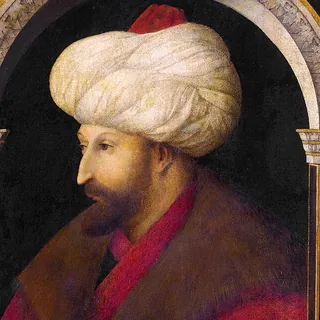
A patron of the arts, he invited Greek scholars and Italian artists; the Venetian Gentile Bellini painted his portrait in 1480. He had collections of laws, the kanunname, drawn up, one of which allowed the sultan to have his brothers executed to prevent wars of succession. In 1480 his troops landed at Otranto in southern Italy. He died on 3 May 1481 near Gebze, during a campaign, possibly poisoned; his tomb is in the Fatih Mosque in Istanbul.
Sources: Wikipédia, « Mehmed II »; Wikipedia, « Mehmed II »; Encyclopædia Britannica, « Mehmed II »
Related event
Also worth discovering
Last updated: