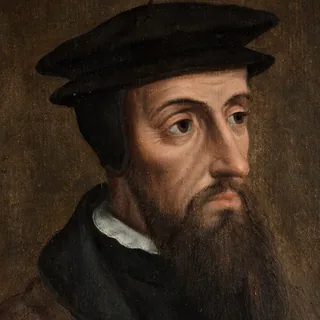
Key Facts
- 10 July 1509: born in Noyon
- 1534: leaves France after the Affair of the Placards
- 1536: publishes the Institutes of the Christian Religion in Basel
- 1538-1541: pastor to the French refugees in Strasbourg
- 1541: Ecclesiastical Ordinances of Geneva
- 1559: founds the Academy of Geneva
- 27 May 1564: dies in Geneva
Biography
John Calvin (1509-1564), a French theologian and reformer, was, with Martin Luther, the greatest figure of the Protestant Reformation. The author of the Institutes of the Christian Religion, he made Geneva, where he spent most of his life, the capital of a “Reformed” Protestantism that spread to France, the Netherlands, Scotland and later North America.
Born Jehan Cauvin on 10 July 1509 in Noyon, in Picardy, the son of a notary in the bishop's service, he was first intended for the priesthood and studied in Paris, at the Collège de Montaigu. His father then steered him towards law, which he studied at Orléans and Bourges, where he also discovered humanism and Greek. Around 1533 he embraced the ideas of the Reformation. Implicated in the scandal caused by a speech by his friend Nicolas Cop, rector of the University of Paris, he had to go into hiding, then leave France after the Affair of the Placards in 1534.
Having taken refuge in Basel, he published there in 1536 the first Latin edition of the Institutes of the Christian Religion, a clear and methodical exposition of the Reformed faith, which he himself translated into French in 1541 and expanded throughout his life. That same year, while passing through Geneva, he was held back by William Farel, who asked him to help organise the Reformation there. Expelled in 1538 after a conflict with the city authorities, the two men parted: in Strasbourg, alongside Martin Bucer, Calvin became pastor to the French refugees, and there he married Idelette de Bure in 1540.
Recalled to Geneva in 1541, he had the Ecclesiastical Ordinances adopted, which organised the Church around pastors, doctors, elders and deacons, and a consistory charged with supervising morals. His theology stressed the absolute sovereignty of God and predestination. His authority, long contested by some of Geneva's leading families, prevailed in the 1550s; in 1553 he approved the burning at the stake of the Spanish physician Michael Servetus, who denied the Trinity, an episode for which he has been criticised ever since.
In 1559 he founded the Academy of Geneva, which trained pastors who were sent all over Europe, especially to France, where Reformed churches multiplied until the Wars of Religion. Worn out by illness and work, he died in Geneva on 27 May 1564, aged fifty-four, and was buried, as he had wished, without a headstone. His writings, composed in a clear style, also played an important part in the history of French prose.
Sources: Wikipédia, « Jean Calvin »; Wikipedia, « John Calvin »
Related event
Also worth discovering
Last updated: