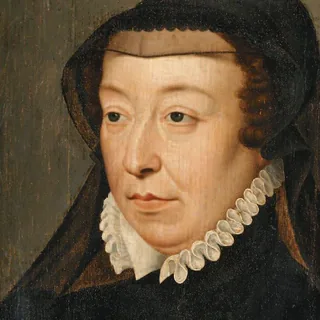
Key Facts
- 13 April 1519: born in Florence
- 28 October 1533: marries the future Henry II in Marseille
- 1547: Queen of France
- 1560: governs the kingdom on behalf of Charles IX
- January 1562: edict allowing Protestant worship outside the towns
- 24 August 1572: St Bartholomew's Day massacre
- 5 January 1589: dies at Blois
Biography
Catherine de' Medici (1519-1589), Queen of France through her marriage to Henry II and then mother of three kings, Francis II, Charles IX and Henry III, played a leading political role for nearly thirty years. Regent at the start of the Wars of Religion, she long sought to reconcile Catholics and Protestants, but her name remains linked with the St Bartholomew's Day massacre of 1572.
Born in Florence on 13 April 1519, the daughter of Lorenzo II de' Medici, Duke of Urbino, and Madeleine de La Tour d'Auvergne, she lost both her parents within weeks of her birth. Brought up in Florence and then in Rome under the protection of the popes of her family, Leo X and then Clement VII, she married in Marseille, on 28 October 1533, Henry, the second son of King Francis I, in the presence of the pope. Dauphine from 1536 and queen from 1547, she had to endure the influence of Diane de Poitiers, the king's favourite, and did not give birth to her first child until after ten years of marriage; she would have ten.
The accidental death of Henry II in 1559, followed by that of Francis II the next year, made her governor of the kingdom on behalf of her ten-year-old son Charles IX. Faced with the spread of Protestantism, she pursued with the Chancellor Michel de L'Hospital a policy of conciliation: she convened the Colloquy of Poissy in 1561 and in January 1562 had an edict signed allowing Protestant worship outside the towns. Yet the massacre of Wassy, in March, sparked the first War of Religion. From 1564 to 1566 she took her son on a tour of the whole kingdom to strengthen royal authority.
To seal the peace, in August 1572 she married her daughter Margaret to the Protestant Henry of Navarre. A few days later, after a failed attempt on the life of Admiral de Coligny, the royal council decided to eliminate the Protestant leaders: this was the St Bartholomew's Day massacre, in which Catherine's share of responsibility is still debated by historians. She went on advising Henry III, king from 1574, and negotiating with both sides.
A great patron of the arts, she had the Tuileries Palace built from 1564, enriched the royal collections and helped to bring Italian taste to France, in architecture as in court festivities. She died at the Château de Blois on 5 January 1589, aged sixty-nine, a few days after the assassination of the Duke of Guise ordered by her son. Long portrayed as a dark and scheming queen, she is today often seen as a stateswoman whose overriding concern was to preserve the monarchy.
Sources: Wikipédia, « Catherine de Médicis »; Wikipedia, « Catherine de' Medici »
Related event
Also worth discovering
Last updated: