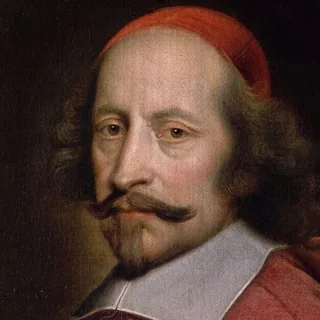
Key Facts
- 14 July 1602: born at Pescina, in the Abruzzi
- 1630: imposes a truce before Casale as the pope's diplomat
- 1641: made a cardinal
- 1643: chief minister to the regent Anne of Austria
- 1648-1653: faces the Fronde
- 1659: Peace of the Pyrenees with Spain
- 9 March 1661: dies at Vincennes
Biography
Jules Mazarin (1602-1661), a cardinal of Italian origin, was chief minister to the regent Anne of Austria and then to the young Louis XIV from 1643 until his death. Richelieu's successor, he pursued his policy against the Habsburgs, secured major territorial gains through the treaties of Westphalia and the Pyrenees and overcame the Fronde, the great revolt of the parlements and the princes. He thus prepared the way for Louis XIV's personal rule.
Born Giulio Mazzarino on 14 July 1602 at Pescina in the Abruzzi, into a family in the service of the Colonna, he studied with the Jesuits in Rome and then in Spain. A captain in the papal army, he became a diplomat in the pope's service and made his name in 1630 before Casale, in northern Italy, by galloping between the French and Spanish armies to announce a truce. Noticed by Richelieu, he entered French service, was naturalised in 1639 and became a cardinal in 1641 without ever having been ordained a priest.
On Richelieu's death in 1642 he joined the King's Council. When Louis XIII died in turn in May 1643, Queen Anne of Austria, regent for her four-year-old son, chose him as chief minister and gave him her complete trust. He continued the Thirty Years' War, and the treaties of Westphalia, signed in 1648, gave France a large part of Alsace and confirmed its possession of Metz, Toul and Verdun. The war against Spain nevertheless continued.
That same year rising taxes and hostility towards this foreign minister provoked the Fronde. The Parlement of Paris rebelled, the court had to flee the capital in January 1649, and then the great princes, such as Condé, took up arms. Targeted by thousands of pamphlets, the mazarinades, Mazarin had to go into exile twice, in 1651 and 1652, while continuing to govern through his letters to the queen. He returned to Paris in triumph in February 1653, once the revolt had been crushed.
Under the Peace of the Pyrenees in 1659 Spain ceded Roussillon and Artois to France, and Louis XIV married the Infanta Maria Theresa in 1660. Mazarin, who had amassed an immense fortune, built up a famous library, open to the public, today's Bibliothèque Mazarine, and bequeathed funds to found the Collège des Quatre-Nations, now the seat of the Institut de France. He died at Vincennes on 9 March 1661. The next day Louis XIV announced that he would henceforth govern alone, without a chief minister.
Sources: Wikipédia, « Jules Mazarin »; Wikipedia, « Cardinal Mazarin »
Related event
Also worth discovering
Last updated: