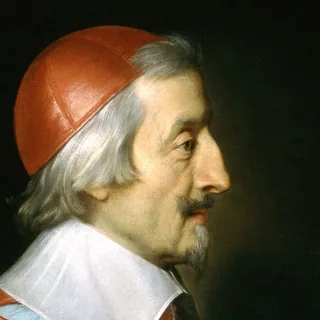
Key Facts
- 9 September 1585: born in Paris
- 1607: Bishop of Luçon at twenty-one
- 1622: made a cardinal
- 1624: enters the King's Council and becomes its head
- October 1628: surrender of La Rochelle
- 1635: founds the Académie française and goes to war with Spain
- 4 December 1642: dies in Paris
Biography
Armand Jean du Plessis, Cardinal Richelieu (1585-1642), was Louis XIII's chief minister from 1624 until his death. A churchman who became a statesman, he devoted his career to strengthening royal authority: he deprived the Protestants of their fortified towns, broke the plots of the great nobles and drew France into the Thirty Years' War against the Habsburgs. He also founded the Académie française.
Born in Paris on 9 September 1585 into a family of the minor nobility of Poitou, he was at first intended for a military career. To keep the bishopric of Luçon in his family, he took holy orders and became a bishop at twenty-one, in 1607. As a deputy of the clergy at the Estates General of 1614, he caught the attention of the Queen Mother, Marie de' Medici, then regent, who brought him into the government in 1616 as Secretary of State. The fall of his patron Concini in 1617 removed him from power, but he later reconciled the Queen Mother and Louis XIII, which earned him a cardinal's hat in 1622.
Having entered the King's Council in 1624, he soon became its head. He first attacked the Protestant party, which formed a state within the state: after a siege of more than a year that he directed in person, La Rochelle surrendered in October 1628. The Peace of Alès in 1629 took away the Protestants' fortified towns but left them the freedom of worship guaranteed by the Edict of Nantes. On the Day of the Dupes in November 1630, the Queen Mother believed she had secured his dismissal, but Louis XIII kept his trust in him and Marie de' Medici was forced into exile.
Richelieu ruthlessly fought the indiscipline of the great nobles. He enforced the ban on duelling, and the Count of Montmorency-Bouteville, who had defied it, was beheaded in 1627; the rebellious Duke of Montmorency met the same fate in 1632, as did the Marquis of Cinq-Mars, who had plotted with Spain, in 1642. He expanded the role of the intendants, the king's representatives in the provinces, and sharply raised taxes to pay for the war, which provoked many peasant revolts, such as that of the Croquants or that of the Va-nu-pieds in Normandy.
To humble the House of Habsburg, which encircled the kingdom, he first supported the Protestant princes of Germany and Sweden, then declared war on Spain in 1635. In the same year he founded the Académie française, charged with codifying the language. A patron of writers and artists, he had the Palais-Cardinal, today's Palais-Royal, built and the Sorbonne rebuilt, of which he was provisor. He died in Paris on 4 December 1642, having designated Mazarin as his successor, and was buried in the chapel of the Sorbonne.
Sources: Wikipédia, « Armand Jean du Plessis de Richelieu »; Wikipedia, « Cardinal Richelieu »
Related event
Also worth discovering
Last updated: