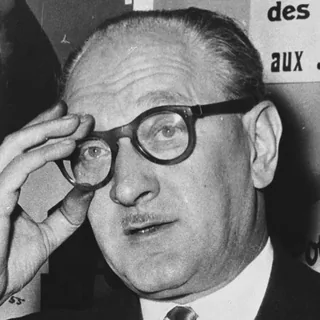
Key Facts
- 31 December 1905: born in Flers
- 1945: elected mayor of Arras
- 1946: secretary-general of the SFIO
- February 1956: Prime Minister
- 6 February 1956: day of the tomatoes in Algiers
- 25 March 1957: signing of the Treaties of Rome
- 3 October 1975: dies in Paris
Biography
Guy Mollet (1905-1975), an English teacher who led the socialist SFIO party for almost a quarter of a century, headed the longest-lasting government of the Fourth Republic, from February 1956 to May 1957. His time in power combined lasting social reforms and the signing of the Treaties of Rome with the escalation of the Algerian War and the Suez expedition.
Born on 31 December 1905 in Flers, in the Orne, into a modest family, he joined the SFIO as early as 1923. Having become an English teacher, he was active in the teachers' unions, which led to his transfer to Arras, a town to which he would remain attached all his life. Mobilised in 1940, he was taken prisoner and released in June 1941; he then joined the Resistance, wrote for the clandestine newspaper La Voix du Nord and took part in the fighting of the Liberation.
Elected mayor of Arras in 1945, an office he held until his death, and then deputy for the Pas-de-Calais, he became secretary-general of the SFIO in 1946 and led it until 1969. Faithful to Marxist doctrine in his speeches but pragmatic in government, he served in several cabinets as minister of state and became an indispensable player in the parliamentary combinations of the Fourth Republic.
After the victory of the Republican Front in the elections of January 1956, he was appointed Prime Minister. On 6 February, in Algiers, he was greeted with tomatoes and threats by the European population; he then gave up a liberal policy and in March secured the vote of special powers, which allowed conscripts to be sent to Algeria in large numbers. In the autumn he committed France, alongside the United Kingdom and Israel, to the Suez expedition, which turned into a diplomatic failure. Yet his government granted independence to Morocco and Tunisia, passed the Defferre framework law for Africa, a third week of paid holidays and an allowance for the elderly, and on 25 March 1957 signed the Treaties of Rome, which created the European Economic Community.
Defeated in a vote on 21 May 1957, he supported General de Gaulle's return in 1958 and served as minister of state until early 1959, before going into opposition to the new regime. Challenged by a new generation of socialists, he gave up the party leadership in 1969, when the SFIO became the Socialist Party. He died of a heart attack in Paris on 3 October 1975, aged sixty-nine. The term “molletisme” has since been used critically for the gap between radical rhetoric and a moderate exercise of power.
Sources: Wikipédia, « Guy Mollet »; Wikipedia, « Guy Mollet »
French heads of government (1956-1957)
Related event
Also worth discovering
Last updated: