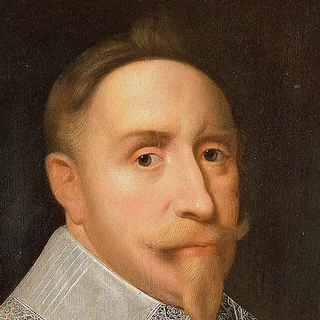
Key Facts
- December 1594: born in Stockholm
- 1611: becomes King of Sweden at sixteen
- 1617: Treaty of Stolbovo, Russia loses access to the Baltic
- 1621: captures Riga and founds Gothenburg
- July 1630: lands in Pomerania and enters the Thirty Years' War
- 17 September 1631: victory over Tilly at Breitenfeld
- 16 November 1632: killed at the Battle of Lützen
Biography
Gustavus Adolphus (1594-1632), King of Sweden from 1611 until his death, made his country one of the great powers of Europe. A reformer of the state and the army, he intervened in the Thirty Years' War on the side of the German Protestants, earned the nickname of “Lion of the North” and fell at the Battle of Lützen.
The son of King Charles IX, he was born in Stockholm in December 1594 and received a careful education: he spoke several languages and was introduced very early to affairs of state and to war. He came to the throne at sixteen, in 1611, when Sweden was at war with Denmark, Russia and Poland. He chose Axel Oxenstierna as his chancellor, who would remain his chief collaborator, and made peace with Denmark in 1613 at the cost of a heavy ransom for the fortress of Älvsborg.
By the Treaty of Stolbovo in 1617 he took Ingria and part of Karelia from Russia, cutting it off from the Baltic. Against the Poland of his cousin Sigismund III, who claimed the Swedish crown, he captured Riga in 1621 and occupied Livonia; the Truce of Altmark in 1629 also gave him the tolls of several Prussian ports. He modernised the administration, founded Gothenburg in 1621 and richly endowed Uppsala University. Above all he reformed the army: national conscription, light and mobile artillery, and smaller units combining musketeers, pikemen and cavalry.
In July 1630, alarmed by the successes of the Catholic Emperor Ferdinand II in Germany, he landed in Pomerania. The Treaty of Bärwalde, signed in 1631 with Richelieu's France, secured him subsidies. On 17 September 1631, at Breitenfeld near Leipzig, he crushed Tilly's imperial army, then crossed Germany as far as the Rhine and entered Munich in 1632. On 16 November 1632, at Lützen in Saxony, his army defeated Wallenstein's, but the king, lost in the fog during a cavalry charge, was killed.
His daughter Christina, aged six, succeeded him under the regency of Oxenstierna, and at the Peace of Westphalia in 1648 Sweden obtained Western Pomerania and other German territories. Gustavus Adolphus left the image of an innovative commander, whom Napoleon counted among the great captains of history. In Sweden, 6 November, the date of his death in the Julian calendar then in use, is Gustavus Adolphus Day.
Sources: Wikipédia, « Gustave II Adolphe »; Wikipedia, « Gustavus Adolphus »; Encyclopédie Larousse, « Gustave II Adolphe »
Kings & Queens of Sweden (1611-1632)
Related event
Also worth discovering
Last updated: