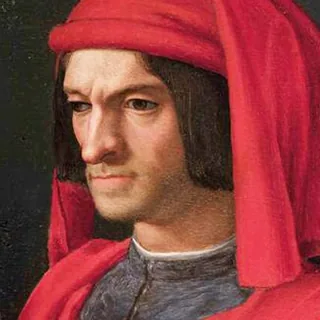
Key Facts
- 1 January 1449: born in Florence
- 1469: at twenty, takes the lead of Florence with his brother Giuliano
- 26 April 1478: escapes the Pazzi conspiracy, in which his brother is killed
- December 1479: secures peace in Naples
- Patron of Botticelli, Poliziano and the young Michelangelo
- 1489: his son Giovanni, the future Leo X, is made a cardinal
- 8 April 1492: dies at Careggi, near Florence
Biography
Lorenzo de' Medici (1449-1492), known as Lorenzo the Magnificent, was the de facto ruler of the Florentine republic from 1469 until his death. A banker, a skilful politician and a poet, he is above all the most famous patron of the Italian Renaissance: Botticelli, Ghirlandaio, the young Michelangelo and the humanist philosophers enjoyed his protection. As a diplomat he helped maintain the balance between the Italian states, which broke down shortly after his death.
Born in Florence on 1 January 1449, the grandson of Cosimo the Elder and son of Piero de' Medici, he received a careful humanist education from masters such as the philosopher Marsilio Ficino. On his father's death in 1469 he took over, at the age of twenty and together with his brother Giuliano, the leadership of the family and the republic without holding any official office: like his grandfather, he governed through influence, his network of allies and the wealth of the family bank.
On 26 April 1478 the rival Pazzi family, backed by Pope Sixtus IV, tried to murder him during Mass in the cathedral. Giuliano was killed, but Lorenzo, though wounded, managed to escape, and the conspirators were massacred by the crowd or executed. The pope excommunicated Lorenzo, and the King of Naples went to war against Florence. In December 1479 Lorenzo travelled to Naples himself, at the risk of his life, and secured peace from King Ferdinand, which greatly increased his prestige.
Lorenzo made his city the artistic and intellectual capital of Italy. He gathered around him the poets and thinkers of the Platonic Academy, such as Angelo Poliziano and Pico della Mirandola, collected antiquities and welcomed the young Michelangelo to the garden of San Marco, giving him lodgings in his palace. He himself wrote poems in Tuscan, including the famous Song of Bacchus: “How beautiful is youth, which is fleeing all the while.”
In politics Lorenzo established himself as the arbiter of the peninsula, committed to the balance between Florence, Milan, Naples, Venice and the papacy. The Medici bank nevertheless declined under his management, and he sometimes handled the state's finances as if they were his own. He obtained a cardinal's hat for his son Giovanni at the age of thirteen; Giovanni would become pope as Leo X. Lorenzo died at his villa at Careggi on 8 April 1492. Two years later the French invasion and the expulsion of the Medici opened a period of turmoil.
Sources: Wikipédia, « Laurent de Médicis »; Wikipedia, « Lorenzo de' Medici »
Related event
Also worth discovering
Last updated: