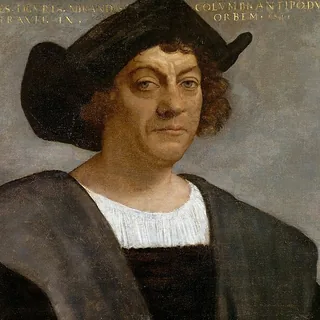
Christopher Columbus
Key Facts
- Born in Genoa in 1451, the son of a weaver
- Won the backing of the Catholic Monarchs with the Capitulations of Santa Fe in April 1492
- Sailed from Palos on 3 August 1492 with the Santa María, the Pinta and the Niña
- Made landfall in the Bahamas on 12 October 1492
- Reached the South American mainland on his third voyage, in 1498
- Arrested in 1500 by Francisco de Bobadilla and sent back to Spain in chains
- Died in Valladolid on 20 May 1506
Biography
Christopher Columbus (1451-1506), a Genoese navigator in the service of the Catholic Monarchs of Spain, made landfall in the Bahamas on 12 October 1492 while seeking a westward route to Asia. His four voyages opened the way for the European colonisation of the Americas, with devastating consequences for Indigenous peoples, which makes him a figure both celebrated and contested.
Born in Genoa in 1451, the son of a weaver, he went to sea in the Mediterranean at a young age, then settled in Portugal after surviving a shipwreck off Lagos in 1476. There he married Filipa Moniz Perestrelo, who bore him a son, Diego. Convinced, through a severe underestimate of the distance, that Asia could be reached by sailing west, he put his plan to King John II of Portugal, whose advisers rejected it around 1484. Settling in Castile from 1485, he finally won the support of Isabella of Castile and Ferdinand of Aragon after the fall of Granada: the Capitulations of Santa Fe, in April 1492, promised him the titles of admiral, viceroy and governor of the lands he would discover.
Setting sail from Palos de la Frontera on 3 August 1492 with three ships, the Santa María, the Pinta and the Niña, he called at the Canary Islands and on 12 October landed on an island in the Bahamas that its inhabitants, the Lucayans, called Guanahani and that he named San Salvador. He then explored the coasts of Cuba and Hispaniola, where the Santa María ran aground on Christmas Day; he left thirty-nine men there in the fort of La Navidad. Back in Palos on 15 March 1493, he was given a triumphant reception by the monarchs in Barcelona. In September 1493 he set out again with seventeen ships and more than a thousand men to colonise Hispaniola, where he founded La Isabela.
Under his governorship the Taíno of Hispaniola were subjected to forced labour, and some 500 captives were shipped to Spain as slaves in 1495. On his third voyage, in 1498, Columbus reached the South American mainland, on the coast of present-day Venezuela. But complaints from the settlers and accusations of brutality led the Crown to send an investigator, Francisco de Bobadilla, who had him arrested and sent back to Spain in chains in 1500. Released but stripped of his governorship, he made a fourth voyage (1502-1504) along the coast of Central America, from Honduras to Panama, and was stranded for a year in Jamaica. He died in Valladolid on 20 May 1506, aged about fifty-four.
His voyages set off an unprecedented exchange of plants, animals and diseases between the Old World and the New, but also the conquest and colonisation of the continent; the Taíno population of Hispaniola collapsed within a few decades as a result of epidemics, violence and forced labour. The continent bears the name of another navigator, Amerigo Vespucci, but Colombia and many cities bear his. The 12th of October, the day of his arrival, is Spain's national day and a public holiday in several countries of the Americas, where it has often been renamed to honour Indigenous peoples or cultural diversity; since 2020 several of his statues have been toppled or removed in the United States.