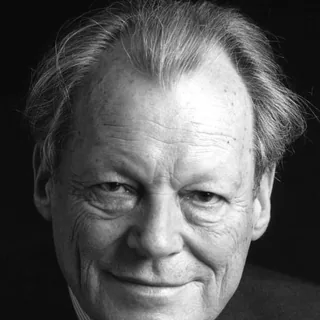
Key Facts
- 18 December 1913: born in Lübeck as Herbert Frahm
- 1933: exile in Norway
- 1957-1966: Governing Mayor of West Berlin
- 21 October 1969: elected Chancellor
- 7 December 1970: kneels in Warsaw
- 1971: Nobel Peace Prize
- 8 October 1992: dies in Unkel
Biography
Willy Brandt (1913-1992), Chancellor of the Federal Republic of Germany from 1969 to 1974, was the first Social Democrat to lead the German government since 1930. His policy of opening to the East, Ostpolitik, symbolised by his kneeling at the Warsaw Ghetto memorial, earned him the Nobel Peace Prize in 1971.
Born on 18 December 1913 in Lübeck as Herbert Frahm, he became active on the left at a very young age. Under threat after the Nazis came to power, he fled to Norway in 1933, where he worked as a journalist and adopted the pseudonym Willy Brandt. Stripped of his German nationality by the Nazi regime, he became a Norwegian citizen in 1940 and then moved to Sweden during the war. Back in Germany after 1945, he regained German nationality and settled in Berlin.
As Governing Mayor of West Berlin from 1957 to 1966, he faced the building of the Berlin Wall in August 1961 and welcomed John Kennedy in 1963. As the SPD's candidate for chancellor in 1961 and 1965, he was defeated both times by the Christian Democrats. Chairman of the Social Democratic Party (SPD) from 1964 to 1987, he became Vice-Chancellor and Foreign Minister in a grand coalition government in 1966. After the 1969 elections he formed a coalition with the liberals of the FDP and was elected Chancellor on 21 October 1969.
His Ostpolitik aimed to normalise relations with the countries of the Soviet bloc. In 1970 he signed the Treaties of Moscow and Warsaw, which recognised the post-war borders. On 7 December 1970, in Warsaw, he knelt before the memorial to the heroes of the Ghetto, a gesture that went around the world. The Basic Treaty of 1972 established relations between the two German states. At home, his government expanded social protection. Wishing to “dare more democracy”, he also had the voting age lowered to eighteen. He survived a no-confidence motion in 1972 and then won the early elections in November.
In May 1974 he resigned after one of his close aides, Günter Guillaume, was found to be an East German spy; Helmut Schmidt succeeded him. He remained an influential figure: he chaired the Socialist International and the North-South Commission, which published its report in 1980, and in 1990 opened the first session of the Bundestag of reunified Germany. He died of cancer in Unkel, near Bonn, on 8 October 1992, aged seventy-eight.
Sources: Wikipédia, « Willy Brandt »; Wikipedia, « Willy Brandt »
German Chancellors (1969-1974)
Related event
Also worth discovering
Portrait (cropped): Engelbert Reineke, Bundesarchiv, CC BY-SA 3.0 DE, Wikimedia Commons

Last updated: