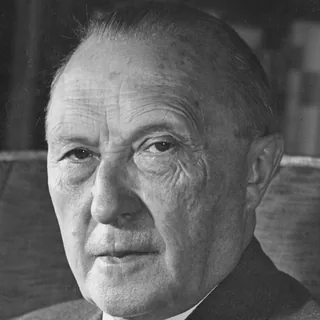
Key Facts
- 5 January 1876: born in Cologne
- 1917-1933: Mayor of Cologne
- 15 September 1949: elected first Chancellor of the Federal Republic of Germany
- 1955: the Federal Republic joins NATO
- 1957: signing of the Treaties of Rome
- 22 January 1963: Élysée Treaty with Charles de Gaulle
- 19 April 1967: dies in Rhöndorf
Biography
Konrad Adenauer (1876-1967), the first Chancellor of the Federal Republic of Germany, from 1949 to 1963, is regarded as the founder of democratic West Germany and as one of the fathers of Europe. He anchored his country in the Western camp, presided over the “economic miracle” and, with General de Gaulle, sealed Franco-German reconciliation.
Born in Cologne on 5 January 1876 into a Catholic family, he studied law and economics, then made his career in municipal administration. A member of the Centre Party, the Catholic party, he was Mayor of Cologne from 1917 to 1933 and, under the Weimar Republic, President of the Prussian State Council. Opposed to the Nazis, he was dismissed in 1933 and briefly imprisoned in 1934 and again in 1944.
After the war he took the lead of the new Christian Democratic Union (CDU) and presided over the Parliamentary Council that drafted the Basic Law, the constitution of the Federal Republic, adopted in 1949. On 15 September 1949, at the age of seventy-three, he was elected the first Chancellor by the Bundestag. He was also his own Foreign Minister from 1951 to 1955. With his Economics Minister, Ludwig Erhard, he presided over the reconstruction and rapid growth of the West German economy, the Wirtschaftswunder or “economic miracle”.
In foreign policy he chose to anchor the country in the West: the Federal Republic joined the European Coal and Steel Community in 1951 and NATO in 1955, and in 1957 signed the Treaties of Rome, which founded the European Economic Community. As early as 1950 he backed the Schuman Plan, which brought France and Germany together in the joint management of coal and steel. In 1952 he concluded a reparations agreement with Israel. In 1955 a visit to Moscow secured the return of the last German prisoners of war. On 22 January 1963 he signed the Élysée Treaty with Charles de Gaulle, the founding act of Franco-German friendship. His policies also drew criticism: he refused to recognise East Germany and the Oder-Neisse border, and his amnesty measures allowed many former Nazis back into public life.
Nicknamed “der Alte” (the Old Man), he governed until the age of eighty-seven. Weakened by the Spiegel affair and pushed out by his own party, he resigned in October 1963 and was succeeded by Ludwig Erhard. He died at his home in Rhöndorf, near Bonn, on 19 April 1967, aged ninety-one. He is now regarded as one of the founding fathers of the European Union.
Sources: Wikipédia, « Konrad Adenauer »; Wikipedia, « Konrad Adenauer »
German Chancellors (1949-1963)
Related event
Also worth discovering
Portrait (cropped): Peter Bouserath, CC BY-SA 3.0 DE, Wikimedia Commons

Last updated: