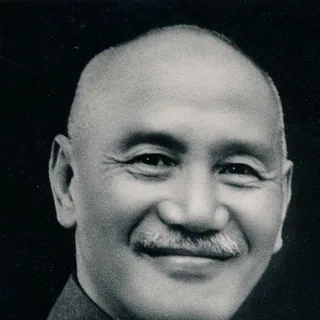
Key Facts
- 31 October 1887: born in Xikou, Zhejiang
- 1924: head of the Whampoa Military Academy
- April 1927: break with the communists, Shanghai massacre
- 1928: reunification of China
- 1943: Cairo Conference with Roosevelt and Churchill
- 1949: retreat to Taiwan
- 5 April 1975: dies in Taipei
Biography
Chiang Kai-shek (1887-1975), a Chinese soldier and statesman, led the Kuomintang, the Nationalist Party, from the death of Sun Yat-sen in 1925 until his own death. He reunified China in 1928, governed it during the war against Japan and then lost the civil war to Mao Zedong's communists. Having fled to Taiwan in 1949, he presided over the Republic of China there under an authoritarian regime until 1975.
Born on 31 October 1887 in Xikou, in Zhejiang province, into a family of salt merchants, he received military training in Japan, where he joined Sun Yat-sen's Tongmenghui. He returned to China to take part in the 1911 Revolution and then became a close associate of Sun. In 1924 Sun put him in charge of the Whampoa Military Academy near Canton, which trained the officers of the Nationalist army.
After Sun's death Chiang took command of the army and in 1926 launched the Northern Expedition against the warlords. In April 1927 he broke violently with his communist allies, who were massacred in Shanghai, and set up his government in Nanjing. The capture of Beijing in 1928 completed the reunification of the country. In December 1927 he had married Soong Mei-ling, Sun Yat-sen's sister-in-law, who would play a major diplomatic role.
He waged several campaigns against the communist bases, which forced the Red Army into the Long March in 1934. In December 1936 in Xi'an one of his generals held him prisoner to force him into an alliance with the communists against Japan. During the Second Sino-Japanese War, from 1937 to 1945, he moved his government to Chongqing and in 1943 attended the Cairo Conference with Roosevelt and Churchill; China became a permanent member of the UN Security Council.
The civil war resumed in 1946. Despite American aid, the Nationalists, undermined by corruption and inflation, were defeated, and Chiang withdrew to Taiwan with nearly two million soldiers and civilians. On the island the suppression of the uprising of 28 February 1947 against the Nationalist authorities had already killed thousands. There he ruled under martial law, repressed all opposition and presented himself as the leader of the only legitimate China, until the UN gave China's seat to Beijing in 1971. He died in Taipei on 5 April 1975; his son Chiang Ching-kuo succeeded him at the head of the island.
Sources: Wikipédia, « Tchang Kaï-chek »; Wikipedia, « Chiang Kai-shek »; Encyclopædia Britannica, « Chiang Kai-shek »
Related event
Also worth discovering
Portrait (cropped): Présidence de la République de Chine (Taïwan), 1955, Wikimedia Commons

Last updated: