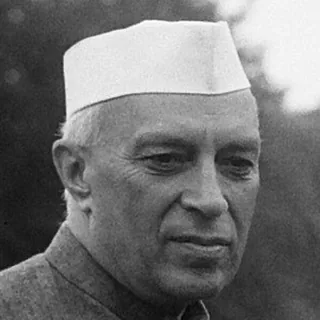
Key Facts
- 14 November 1889: born in Allahabad
- 1912: barrister, returns to India
- 1929: president of the Congress, demand for complete independence
- 1942: arrested during the Quit India movement
- 15 August 1947: first prime minister of independent India
- 1961: co-founder of the Non-Aligned Movement
- 27 May 1964: dies in New Delhi
Biography
Jawaharlal Nehru (1889-1964), an Indian lawyer and politician, was one of the main leaders of the Indian independence movement alongside Gandhi, and then the country's first prime minister, from 1947 until his death. He built modern India on parliamentary democracy, secularism and a planned economy, and made his country one of the leaders of the Non-Aligned Movement during the Cold War.
Born on 14 November 1889 in Allahabad, the son of Motilal Nehru, a wealthy lawyer and leader of the Indian National Congress, he was educated by British tutors and then went to England, where he studied at Harrow School and the University of Cambridge before becoming a barrister in London. Back in India in 1912, he married Kamala Kaul in 1916; their only child, Indira, was born in 1917.
Shaken by the Amritsar massacre in 1919, he joined Gandhi and the campaign of non-cooperation with the British. In all he spent nearly nine years in prison, where he wrote several books, including an autobiography and The Discovery of India. As president of the Congress in 1929, he had the demand for complete independence, Purna Swaraj, adopted at Lahore. Gandhi named him his political heir.
Arrested during the Quit India movement of 1942, he was released in 1945 and negotiated independence with the British. At midnight on 15 August 1947 he declared before the Constituent Assembly that India was awakening “to life and freedom”. As prime minister he had to deal with the violence of partition, the arrival of millions of refugees and the first war with Pakistan over Kashmir. In January 1948 he announced Gandhi's assassination on the radio: “The light has gone out of our lives.” The constitution of 1950 made India a federal republic.
Nehru launched five-year plans inspired by the Soviet model and developed heavy industry, dams and institutes of technology. On the international stage he refused to choose between the two blocs, took part in the Bandung Conference in 1955 and then in the founding of the Non-Aligned Movement in 1961. Defeat in 1962 by China, with which he had signed the Five Principles of Peaceful Coexistence in 1954, weakened him. He died in New Delhi on 27 May 1964; his daughter Indira Gandhi became prime minister in 1966, and his birthday is celebrated in India as Children's Day.
Sources: Wikipédia, « Jawaharlal Nehru »; Wikipedia, « Jawaharlal Nehru »; Encyclopædia Britannica, « Jawaharlal Nehru »
Prime Ministers of India (1947-1964)
Related event
Also worth discovering
Last updated: