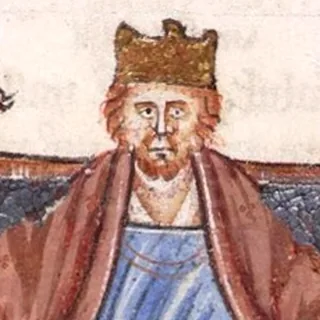
Key Facts
- 5 March 1133: born in Le Mans, son of Geoffrey Plantagenet and the Empress Matilda
- 1152: marriage to Eleanor of Aquitaine
- 19 December 1154: crowned at Westminster
- 1166: Assize of Clarendon, reform of royal justice
- 29 December 1170: murder of Thomas Becket in Canterbury Cathedral
- 1171: lands in Ireland and takes the title of Lord of Ireland
- 6 July 1189: dies at Chinon; buried at Fontevraud
Biography
Henry II (1133-1189), King of England from 1154 until his death, was the first monarch of the Plantagenet dynasty. Master of England and of the whole western half of France, from Normandy to the Pyrenees, he ruled over a realm that historians call the Angevin Empire. His legal reforms laid the foundations of the common law, but his reign is remembered above all for the murder of Archbishop Thomas Becket and for the revolts of his sons.
Born in Le Mans on 5 March 1133, he was the eldest son of Geoffrey Plantagenet, Count of Anjou, and the Empress Matilda, daughter of King Henry I of England. He grew up during the civil war known as the Anarchy, in which his mother fought King Stephen for the English crown. His father entrusted him with Normandy in 1150; on his father's death in 1151, Henry also inherited Anjou, Maine and Touraine. In 1152 he married Eleanor of Aquitaine, newly separated from King Louis VII of France, and thus became master of Aquitaine. The Treaty of Wallingford in 1153 made him Stephen's heir.
Having become king on Stephen's death, he was crowned at Westminster on 19 December 1154. He had the castles built without licence during the civil war pulled down, restored the royal finances and regained control of the Welsh and Scottish borders. His reforms, including the Assize of Clarendon of 1166, extended royal justice, the use of juries and the work of itinerant justices: they are often regarded as the foundations of the English common law. In 1171 he landed in Ireland and took the title of Lord of Ireland.
To bring the Church under his authority, he made his friend and chancellor Thomas Becket Archbishop of Canterbury in 1162. But Becket rejected the Constitutions of Clarendon, which in 1164 curbed the privileges of the clergy, and went into exile in France. Shortly after his return, he was murdered in his cathedral by four knights from the king's household on 29 December 1170. The scandal was immense: Becket was canonised as early as 1173, and Henry II had to do public penance at his tomb in 1174.
The king's last years were darkened by revolts within his family. In 1173 and 1174 his sons, backed by their mother and by Louis VII, rose against him; Henry II prevailed and had Eleanor confined for many years. In 1189 his son Richard allied himself with the new King of France, Philip II Augustus: defeated and ill, Henry II died at Chinon on 6 July 1189. He was buried at Fontevraud Abbey. He was succeeded by Richard the Lionheart and then by his youngest son, John, under whose rule the Angevin Empire fell apart.
Sources: Wikipédia, « Henri II (roi d'Angleterre) »; Wikipedia, « Henry II of England »
Kings & Queens of England (1154-1189)
Also worth discovering
Last updated: