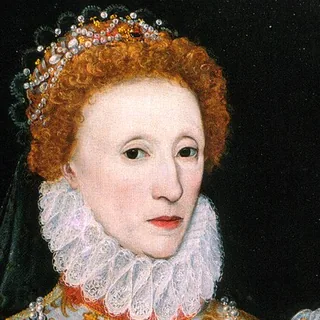
Key Facts
- 7 September 1533: born at Greenwich, daughter of Henry VIII and Anne Boleyn
- 17 November 1558: accession; coronation on 15 January 1559
- 1559: Acts of Supremacy and Uniformity, Anglican religious settlement
- 1570: excommunicated by Pope Pius V
- 8 February 1587: execution of Mary, Queen of Scots
- 1588: defeat of the Spanish Armada
- 24 March 1603: dies at Richmond Palace, end of the Tudor dynasty
Biography
Elizabeth I (1533-1603), Queen of England and Ireland from 1558 until her death, was the last monarch of the Tudor dynasty. Her forty-four-year reign, which gave its name to the Elizabethan era, saw the consolidation of the Church of England, victory over the Spanish Armada and a great flowering of the theatre, with Shakespeare and Marlowe.
Born at Greenwich Palace on 7 September 1533, she was the daughter of Henry VIII and Anne Boleyn. Her mother was executed in 1536, when she was not yet three, and she was declared illegitimate, before her father restored her to the line of succession. She received a thorough humanist education. Under the reign of her Catholic half-sister Mary I, she was suspected of supporting a Protestant rebellion in 1554 and was confined in the Tower of London, then placed under house arrest: her detention lasted nearly a year.
She became queen on Mary's death, on 17 November 1558, and was crowned on 15 January 1559. That same year the Act of Supremacy and the Act of Uniformity established a moderate Protestant religious settlement, which made her “Supreme Governor” of the Church of England. Cautious by nature, she avoided any systematic persecution of Catholics, but Pope Pius V excommunicated her in 1570. Elizabeth never married and had no children, which earned her the nickname of the “Virgin Queen”, despite many suitors, among them Robert Dudley and several foreign princes.
The Catholic Queen of Scotland, Mary, Queen of Scots, who had fled to England in 1568 and been held captive there, became the focus of plots against Elizabeth; she was executed on 8 February 1587. The following year Philip II of Spain launched the Armada against England, which was defeated in 1588 by the English fleet and by storms. At sea, Francis Drake sailed around the world between 1577 and 1580, and Walter Raleigh tried to found a colony in Virginia, a region named in honour of the queen. Elizabeth also supported the Protestant rebels in the Netherlands against Spain.
The end of the reign was darkened by a long war in Ireland and by the rebellion of the Earl of Essex, a former favourite of the queen, who was executed in 1601. Elizabeth I died at Richmond Palace on 24 March 1603, aged sixty-nine. Her cousin James VI of Scotland, the son of Mary, Queen of Scots, succeeded her as James I, uniting the crowns of England and Scotland for the first time. Her motto, “Video et taceo” (“I see and keep silent”), sums up the image of a prudent ruler who restored stability after the short and troubled reigns of her half-brother and half-sister.
Sources: Wikipédia, « Élisabeth Ire (reine d'Angleterre) »; Wikipedia, « Elizabeth I »
Kings & Queens of England (1558-1603)
Also worth discovering
Last updated: