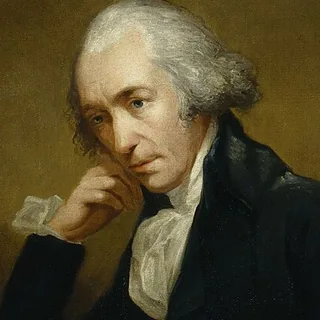
Key Facts
- 19 January 1736: born at Greenock, Scotland
- 1757: instrument maker at the University of Glasgow
- 1769: patent for the separate condenser
- 1775: partnership with Matthew Boulton in Birmingham
- 1780s: rotary motion, double action and the centrifugal governor
- 1800: retires from business
- 25 August 1819: dies at Handsworth, near Birmingham
Biography
James Watt (1736-1819), a Scottish engineer, improved the steam engine to the point of making it the driving force of the Industrial Revolution. His invention of the separate condenser, patented in 1769, sharply reduced coal consumption, and his successive improvements made it possible to drive factory machinery. In partnership with the industrialist Matthew Boulton, he spread his engines through mines and manufactories. The unit of power, the watt, bears his name.
Born on 19 January 1736 at Greenock, a port on the Clyde in Scotland, the son of a shipwright and merchant, he showed an early taste for mechanics and mathematics. After an apprenticeship in London, he became a scientific instrument maker at the University of Glasgow in 1757. There he befriended scientists such as the chemist Joseph Black, who was studying latent heat, and became interested in steam.
In 1763 or 1764 he was asked to repair a scale model of the Newcomen engine, which had been used since the beginning of the century to pump water out of mines. He noticed that it wasted most of its energy heating and then cooling the same cylinder. In 1765, during a walk, he had the idea of condensing the steam in a separate chamber, which allowed the cylinder to be kept hot at all times. The patent was filed in 1769, but development was slow, and his first partner, John Roebuck, went bankrupt.
In 1775 Watt went into partnership with Matthew Boulton, owner of the Soho Manufactory near Birmingham, and Parliament extended his patent until 1800. Boulton and Watt engines were first installed in the tin mines of Cornwall, which saved a great deal of coal as a result. Watt then invented a system converting the piston's back-and-forth motion into rotary motion, the double-acting engine, parallel motion and the centrifugal governor, which keeps the speed constant. His engines could now drive spinning mills, flour mills and forges.
To sell his engines, Watt defined “horsepower”, a unit comparing their power with that of the horses they replaced. A member of the Lunar Society of Birmingham, a circle of scientists and industrialists, he also invented a letter-copying press. Retiring from business in 1800 a wealthy man, he left the firm to his son James and to Boulton's son, and died on 25 August 1819 at Handsworth, near Birmingham. In 1882 the British Association for the Advancement of Science gave his name to the unit of electrical power, the watt.
Sources: Wikipédia, « James Watt »; Wikipedia, « James Watt »
Related event
Also worth discovering
Last updated: