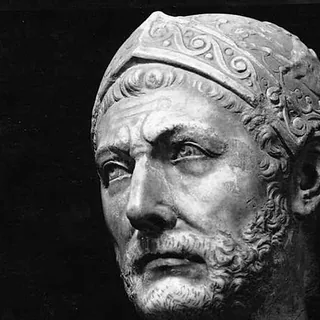
Key Facts
- c. 247 BC: born in Carthage
- 221 BC: takes command of the Carthaginian army in Spain
- 218 BC: crosses the Pyrenees and then the Alps with his elephants
- 2 August 216 BC: victory at Cannae
- 202 BC: defeated by Scipio at Zama
- 196 BC: elected suffete of Carthage
- c. 183 BC: takes poison in Bithynia to escape the Romans
Biography
Hannibal Barca (c. 247-183 BC), a Carthaginian general, was one of the greatest strategists of antiquity. During the Second Punic War he crossed the Alps with his army and his elephants and inflicted on Rome, in Italy itself, some of the worst defeats in its history.
The son of Hamilcar Barca, who had commanded the Carthaginians in Sicily during the First Punic War, he was born in Carthage around 247 BC. According to the historian Polybius, his father made him swear, as a child, eternal hatred of Rome before taking him to Spain, where the Barcids were building a new Carthaginian empire. On the death of his brother-in-law Hasdrubal the Fair in 221 BC, the army chose him as its commander. In 219 BC he besieged and took Saguntum, a city allied to Rome, which triggered the war.
In the spring of 218 BC Hannibal left Spain with several tens of thousands of men and a few dozen elephants. He crossed the Pyrenees, the Rhône and then the Alps in the autumn, and reached the Po plain with a sorely tried army. Reinforced by the Gauls, he defeated the Romans on the Trebia that same year, then at Lake Trasimene in 217 BC. On 2 August 216 BC, at Cannae, in Apulia, he surrounded and annihilated a Roman army far larger than his own: the battle remains the most famous example of an encircling manoeuvre.
Rome nevertheless refused to negotiate. Hannibal did not march on the city, which he did not consider himself able to besiege, and failed to detach Rome's Italian allies for good, despite the defection of Capua. For fifteen years he held the field in southern Italy without receiving adequate reinforcements; his brother Hasdrubal, who had come to join him, was killed on the Metaurus in 207 BC. Recalled to Africa to defend Carthage, Hannibal was defeated at Zama by Scipio Africanus in 202 BC.
Elected suffete, one of the two highest magistrates of Carthage, in 196 BC, he reformed the city's finances, but his opponents denounced him to the Romans and he had to flee. He entered the service of the Seleucid king Antiochus III, then of King Prusias I of Bithynia. About to be handed over to the Romans, he took poison at Libyssa around 183 BC. His campaigns, studied in military academies to this day, have made him the model of the daring commander.
Sources: Wikipédia, « Hannibal Barca »; Wikipedia, « Hannibal »; Encyclopédie Larousse, « Hannibal »
Related event
Also worth discovering
Last updated: