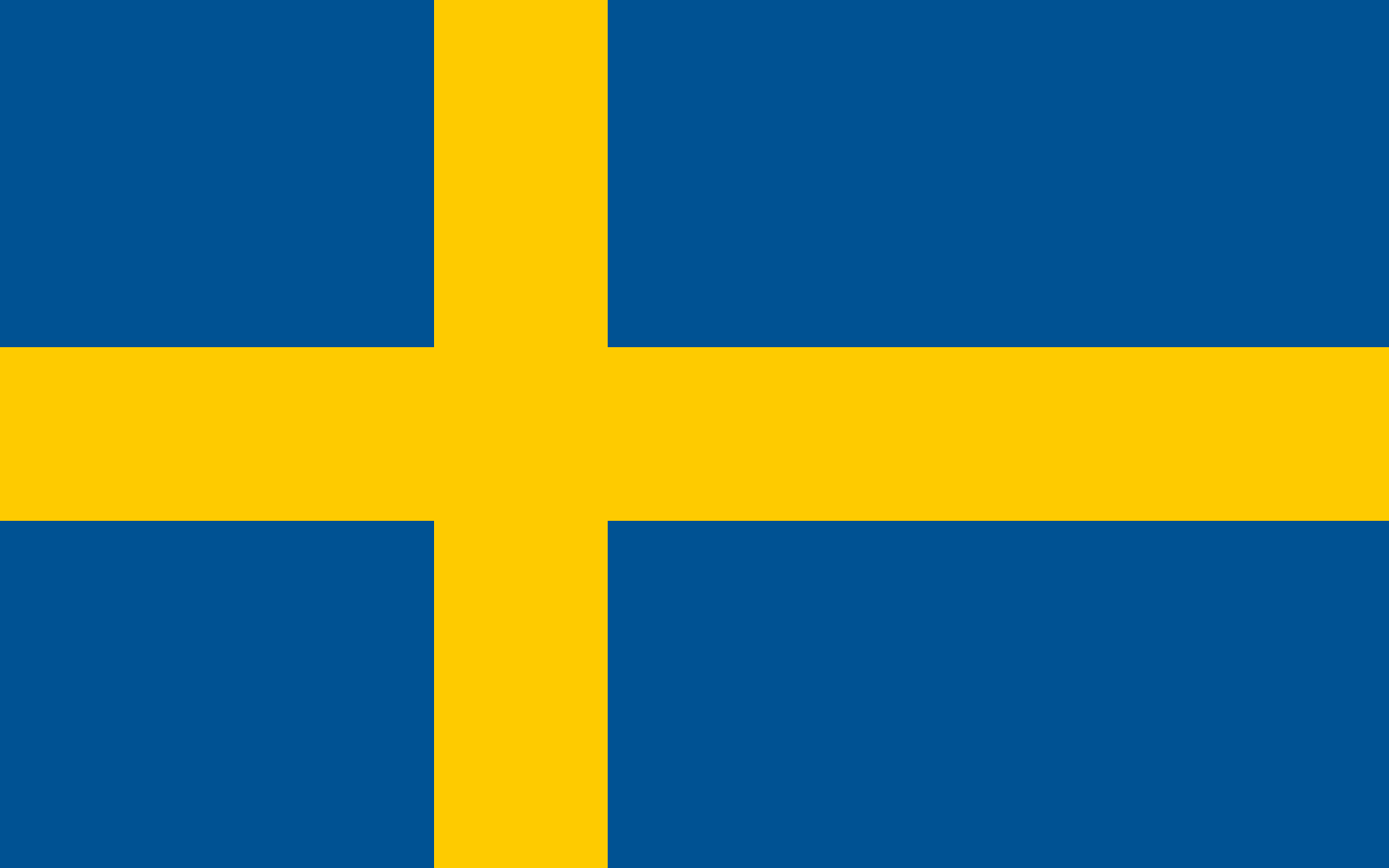
Adopted in 1906
| Capital | Stockholm |
|---|---|
| Population | 10 569 709 inh. |
| Area | 528 860 km² |
| Population density | 20.0 inh./km² |
| Local time | --:-- |
| Language(s) | Swedish |
| Political system | Unitary parliamentary constitutional monarchy |
| National motto | För Sverige i tiden (For Sweden, With the Times) |
| National anthem | Du gamla, du fria (Thou ancient, thou free) |
| Currency | Swedish krona (SEK) |
| History | View timeline |
| Land borders | Norway, Finland, Denmark |
| Maritime borders | Baltic Sea |
The flag: history and symbolism
Flag History
The colours of the Swedish flag, blue and yellow, are those of the arms of Sweden: three golden crowns on a blue field, an emblem attested since the 14th century, and the great coat of arms of the realm, quartered by a golden cross.
The flag with a yellow cross on a blue field appeared in the 16th century, under the kings of the Vasa dynasty: according to tradition, King John III ordered in 1569 that Swedish standards should bear a yellow cross. The shape of the cross, offset towards the hoist, was inspired by the Dannebrog, the Danish flag, like that of the other Nordic flags.
From 1844 to 1905, during the union between Sweden and Norway, the flag bore in its canton a union mark combining the colours of the two countries. After the union was dissolved in 1905, the law of 22 June 1906 established the current flag, without the mark.
Meaning of Colours & Emblems
The Swedish flag has no official symbolism attached to each colour, but its elements are closely linked to the history of the kingdom:
- Blue and yellow: the colours of the arms with the three crowns, the emblem of Sweden since the Middle Ages.
- Nordic cross: inherited from the Christian tradition and shared by all the Nordic countries, it expresses a common regional identity.
6 June, the national day, was first celebrated as ‘Swedish Flag Day’ from 1916. It commemorates the election of Gustav Vasa as king in 1523 and the adoption of the Constitution of 1809.
Anecdotes & Fun Facts
The union mark of 1844, which combined the Swedish and Norwegian colours in the canton of both flags, was mockingly nicknamed sillsallaten, ‘the herring salad’, because of its motley appearance.
According to a legend modelled on that of the Dannebrog, King Eric IX saw a golden cross standing out against the blue sky during a crusade to Finland in the 12th century. No contemporary source confirms the story.
Proclaimed the national day in 1983, 6 June only became a public holiday in 2005, replacing Whit Monday, which lost that status.
Similar Flags Around the World


Sport and history
Olympic Games
History
Frequently asked questions
What is the capital of Sweden?
Stockholm is the capital of Sweden.
What do the colours of the flag of Sweden mean?
The Swedish flag has no official symbolism attached to each colour, but its elements are closely linked to the history of the kingdom: Blue and yellow: the colours of the arms with the three crowns, the emblem of Sweden since the Middle Ages. Nordic cross: inherited from the Christian tradition and shared by all the Nordic countries, it expresses a common regional identity. 6 June, the national day, was first celebrated as ‘Swedish Flag Day’ from 1916. It commemorates the election of Gustav Vasa as king in 1523 and the adoption of the Constitution of 1809.