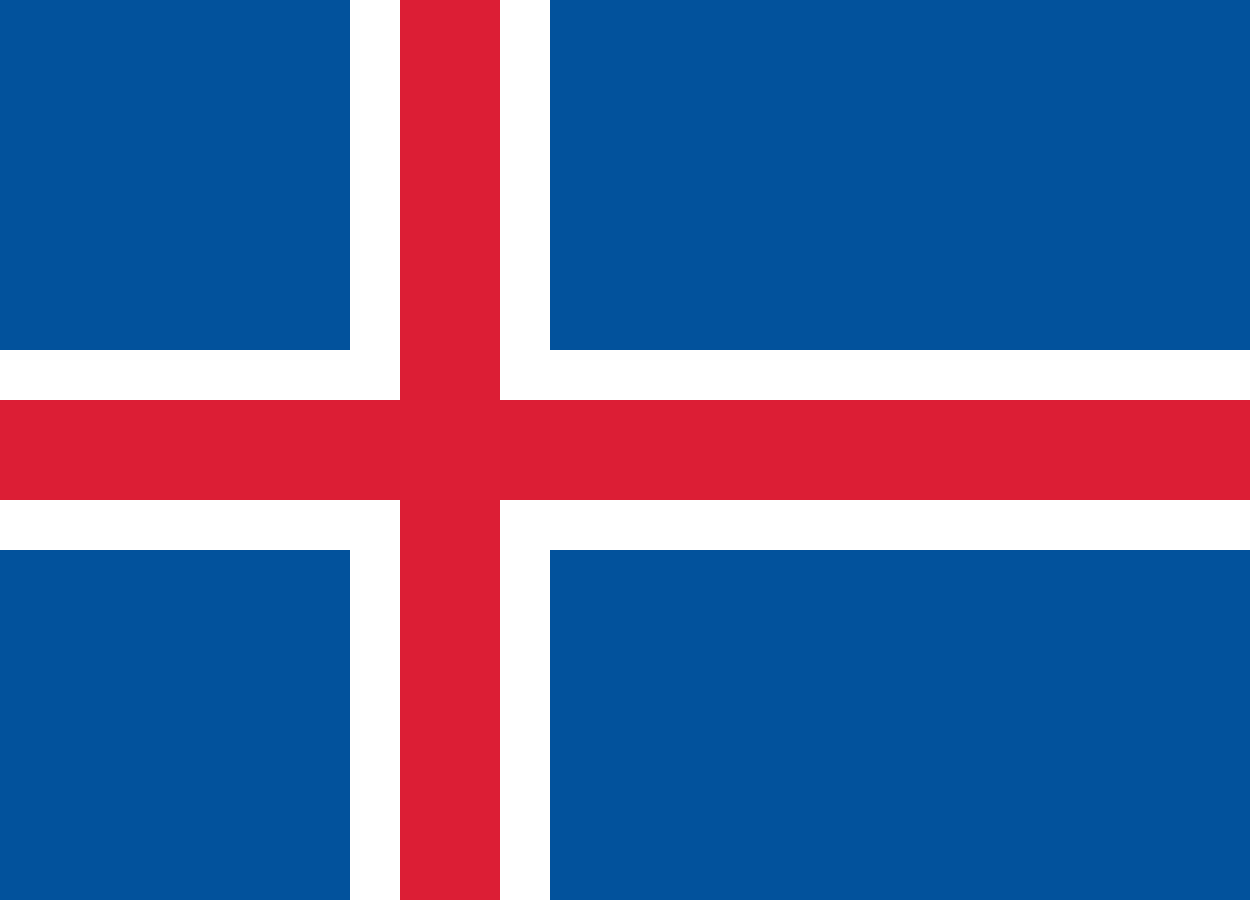
Adopted in 1915
| Capital | Reykjavík |
|---|---|
| Population | 404 610 inh. |
| Area | 103 000 km² |
| Population density | 3.9 inh./km² |
| Local time | --:-- |
| Language(s) | Icelandic |
| Political system | Unitary parliamentary republic |
| National anthem | Lofsöngur (Hymn) |
| Currency | Icelandic króna (ISK) |
| Maritime borders | Atlantic Ocean, Norwegian Sea |
The flag: history and symbolism
Flag History
For centuries Iceland, under Danish rule, had no flag of its own: a dried cod, and later a falcon, served as its emblems. At the end of the 19th century, the poet Einar Benediktsson proposed a white cross on a blue field, the Hvítbláinn (‘the blue and white’), which became the flag of the supporters of self-government.
On 19 June 1915, King Christian X approved the current flag, a red cross edged in white on a blue field, initially for use on land and in Icelandic waters only. It became the flag of the Kingdom of Iceland on 1 December 1918, when the country gained sovereignty in a personal union with Denmark.
When the Republic was proclaimed on 17 June 1944, a law on the national flag confirmed the design and set its colours and proportions.
Meaning of Colours & Emblems
No interpretation is written into law, but the most widespread reading links the colours to the island's landscapes:
- Blue: the mountains and the ocean surrounding the island.
- White: ice and snow.
- Red: the fire of the volcanoes.
- Nordic cross: it recalls Iceland's ties with the other Nordic countries and the Christian tradition.
Anecdotes & Fun Facts
On 12 June 1913, the young Einar Pétursson rowed around Reykjavík harbour with the blue and white flag at the stern of his boat. The captain of the Danish guard ship Islands Falk had the flag seized, which caused public outrage and hastened the recognition of an Icelandic flag.
The Icelandic flag is very close to that of Norway, with the colours reversed: a red cross on a blue field for Iceland, a blue cross on a red field for Norway.
Icelandic law strictly regulates the use of the flag: it must not touch the ground, must not be raised before 7 a.m. and should, as a rule, be lowered at sunset.
Similar Flags Around the World


Sport and history
Olympic Games
Frequently asked questions
What is the capital of Iceland?
Reykjavík is the capital of Iceland.
What do the colours of the flag of Iceland mean?
No interpretation is written into law, but the most widespread reading links the colours to the island's landscapes: Blue: the mountains and the ocean surrounding the island. White: ice and snow. Red: the fire of the volcanoes. Nordic cross: it recalls Iceland's ties with the other Nordic countries and the Christian tradition.