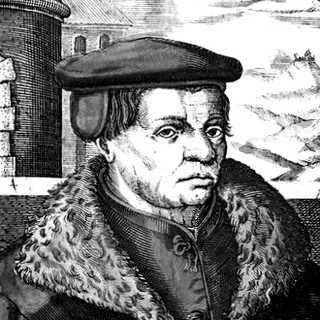
Key Facts
- c. 1489: born in Stolberg
- 1519: meets Luther in Leipzig
- 1520: preacher in Zwickau
- 1521: Prague Manifesto
- July 1524: Sermon to the Princes
- 15 May 1525: defeat at Frankenhausen
- 27 May 1525: beheaded near Mühlhausen
Biography
Thomas Müntzer (c. 1489-1525), a German priest and theologian, was one of the most radical figures of the Reformation. At first close to Martin Luther, he broke with him and preached a complete transformation of the Church and of society, in the name of a direct revelation of the Spirit. Spiritual leader of the rebel peasants of Thuringia, he was captured after the defeat at Frankenhausen and executed in 1525.
Born around 1489 in Stolberg, in the Harz, into a family of modest means, he studied at Leipzig and then at Frankfurt an der Oder, and became a priest. Confessor to a convent of nuns and a reader of the German mystics and the Church Fathers, he met Luther in 1519, at the time of the Leipzig Disputation, and embraced his ideas. On Luther's recommendation he became a preacher in Zwickau in 1520, where his fiery sermons against the clergy and his links with a group of visionary craftsmen, the “Zwickau prophets”, caused unrest and his expulsion in 1521.
He then went to Bohemia and published in Prague a manifesto announcing the coming of a new Church, purified by the Spirit. Back in Germany, in 1523 he became pastor at Allstedt, in Saxony, where he celebrated one of the first services entirely in German and married a former nun. In July 1524, in his Sermon to the Princes, he called on the dukes of Saxony to take up the sword against the godless, warning that otherwise power would pass to the people.
Now in open conflict with Luther, whom he accused of indulgence towards the powerful and mocked as “the soft-living flesh of Wittenberg”, he had to flee Allstedt. He settled in Mühlhausen, in Thuringia, where he allied himself with the preacher Heinrich Pfeiffer and founded an “Eternal League of God”. When the Peasants' War broke out in southern Germany and spread to Thuringia in the spring of 1525, he joined the insurgents, who demanded the abolition of serfdom and an end to seigneurial abuses.
On 15 May 1525 the princes' army crushed the peasants at Frankenhausen; thousands of them were killed. Hiding in the town, Müntzer was discovered, tortured and then beheaded near Mühlhausen on 27 May 1525, together with Pfeiffer. Long portrayed as a fanatic, he was rehabilitated in the nineteenth century by Friedrich Engels as a forerunner of the class struggle, and the German Democratic Republic made him a national hero, putting his portrait on its five-mark banknote. Historians today see him above all as an apocalyptic theologian.
Sources: Wikipédia, « Thomas Müntzer »; Wikipedia, « Thomas Müntzer »
Related event
Also worth discovering
Last updated: