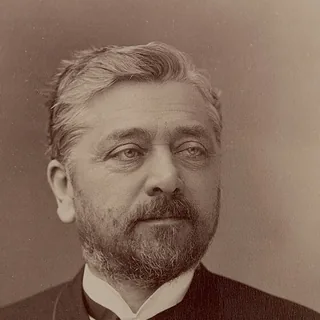
Key Facts
- 15 December 1832: born in Dijon
- 1855: graduates from the École Centrale
- 1866: founds his metal construction company
- 1884: Garabit viaduct
- 1886: inauguration of the Statue of Liberty, whose structure he designed
- 31 March 1889: completion of the Eiffel Tower
- 27 December 1923: dies in Paris
Biography
Gustave Eiffel (1832-1923), a French engineer and industrialist, was one of the great builders of the iron age. His company built bridges, stations and metal frameworks all over the world, from the internal structure of the Statue of Liberty to the Garabit viaduct. His name remains attached to the three-hundred-metre tower erected for the Exposition Universelle of 1889, which became the symbol of Paris.
Born in Dijon on 15 December 1832 as Bonickhausen dit Eiffel, into a family of Rhineland origin that had settled in France in the early eighteenth century, he officially took the name Eiffel alone only in 1880. A graduate of the École Centrale des Arts et Manufactures in 1855, he went into the railway industry and at twenty-six directed the building of the railway bridge over the Garonne in Bordeaux, where he perfected a compressed-air foundation technique. In 1866 he founded his own metal construction company, based at Levallois-Perret.
His workshops produced ever more daring works, thanks to precise calculations of wind resistance and the use of prefabricated parts assembled on site. He built the Western Railway Station in Budapest, the Maria Pia Bridge over the Douro in Porto, completed in 1877, and then the Garabit viaduct in the Cantal, which spans the Truyère more than a hundred and twenty metres above the river. He also designed the metal framework of the Statue of Liberty, a gift from France to the United States inaugurated in New York in 1886.
For the Exposition Universelle celebrating the centenary of the Revolution in 1889, his company built in just over two years a tower of puddled iron conceived by his engineers Maurice Koechlin and Émile Nouguier. Criticised by many artists, it was a huge popular success. That same year Eiffel was implicated in the Panama scandal, having designed the canal's locks: convicted in 1893, he had his sentence quashed by the Court of Cassation, but withdrew from business.
He devoted the end of his life to science. He fitted the tower with meteorological instruments and had a wireless telegraphy aerial installed at its top, which saved the monument from planned demolition. A pioneer of aerodynamics, he built wind tunnels on the Champ de Mars and then at Auteuil, where he studied air resistance on aircraft wings. He died in Paris on 27 December 1923, aged ninety-one.
Sources: Wikipédia, « Gustave Eiffel »; Wikipedia, « Gustave Eiffel »
Also worth discovering
Last updated: