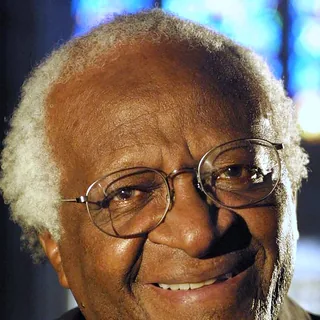
Key Facts
- 7 October 1931: born in Klerksdorp, in the Transvaal
- 1961: ordained an Anglican priest
- 1975: first Black Dean of Johannesburg cathedral
- 1978: General Secretary of the South African Council of Churches
- 1984: Nobel Peace Prize
- 1986: first Black Archbishop of Cape Town
- 26 December 2021: dies in Cape Town
Biography
Desmond Tutu (1931-2021), the Anglican Archbishop of Cape Town, was one of the great figures of the non-violent struggle against apartheid in South Africa, for which he was awarded the Nobel Peace Prize in 1984. After the end of the segregation regime, he chaired the Truth and Reconciliation Commission, tasked with bringing to light the crimes committed under apartheid. He coined the expression “Rainbow Nation”.
Born on 7 October 1931 in Klerksdorp, in the Transvaal, the son of a teacher, Desmond Mpilo Tutu became a teacher himself, lacking the money for the medical studies he had dreamed of after recovering from tuberculosis. In 1955 he married Leah Shenxane, with whom he would have four children. He left teaching in protest against the Bantu Education Act, which gave Black pupils an inferior education, and turned to the Anglican Church: he was ordained a priest in 1961 and then continued his theological studies at King's College London.
Back in southern Africa, he taught theology before becoming, in 1975, the first Black Dean of St Mary's Cathedral in Johannesburg. Bishop of Lesotho in 1976, he took charge of the South African Council of Churches in 1978. There he tirelessly denounced apartheid, called for international economic sanctions against the regime and argued for non-violent struggle, which led to his being kept under surveillance and repeatedly deprived of his passport.
In 1984 he was awarded the Nobel Peace Prize for his role in the non-violent campaign against apartheid. Bishop of Johannesburg in 1985, he became in 1986 the first Black Archbishop of Cape Town and head of the Anglican Church of Southern Africa. He led large peaceful marches and several times intervened in person to protect people threatened with lynching. When Nelson Mandela was released in 1990, he spent his first night of freedom at Tutu's home.
In 1995 President Mandela appointed him to head the Truth and Reconciliation Commission, which from 1996 to 1998 heard thousands of victims and perpetrators, in exchange for an amnesty for those who confessed their political crimes. Having retired as archbishop in 1996, he remained a respected moral voice, not hesitating to criticise the leaders of the ANC and to defend people living with AIDS and the rights of gay people. He died in Cape Town on 26 December 2021, at the age of 90.
Sources: Wikipédia, « Desmond Tutu »; Wikipedia, « Desmond Tutu »; NobelPrize.org, « Desmond Tutu, Facts »
Related event
Also worth discovering
Last updated: