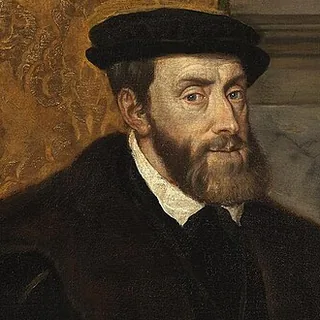
Key Facts
- 24 February 1500: born in Ghent
- 1516: King of Castile and Aragon
- 28 June 1519: elected Holy Roman Emperor
- 1525: victory at Pavia, Francis I taken prisoner
- 1530: crowned by the pope at Bologna
- 25 October 1555: abdicates in Brussels
- 21 September 1558: dies at the monastery of Yuste
Biography
Charles V (1500-1558), King of Spain as Charles I from 1516 and Holy Roman Emperor from 1519 to 1556, was the most powerful ruler in sixteenth-century Europe. Heir at once to the Habsburgs, the Dukes of Burgundy and the Catholic Monarchs, he reigned over Spain, the Netherlands, much of Italy, Germany and a vast American empire on which, it was said, the sun never set.
Born in Ghent on 24 February 1500, he was the son of Philip the Handsome and Joanna of Castile, known as Joanna the Mad. His grandparents were Emperor Maximilian I, Mary of Burgundy, Ferdinand of Aragon and Isabella of Castile. Lord of the Netherlands from his father's death in 1506, he was brought up in Mechelen by his aunt Margaret of Austria. On Ferdinand's death in 1516 he inherited the crowns of Castile and Aragon, which he shared in title with his mother, who was considered unfit to rule.
On 28 June 1519, thanks to money from the Fugger bankers, he was elected emperor against King Francis I of France, and was crowned at Aachen in 1520. His reign opened with crises: the revolt of the Comuneros of Castile, defeated in 1521, and the Reformation, whose initiator, Martin Luther, he summoned before the Diet of Worms that same year. His rivalry with Francis I then dominated his policy: at Pavia in 1525 his troops took the King of France prisoner, and in 1527 his mutinous soldiers sacked Rome. In 1530, at Bologna, he became the last emperor to be crowned by a pope.
During his reign the conquistadors Hernán Cortés and Francisco Pizarro subdued the Aztec and Inca empires, and American gold and silver flowed into Spain. In the east, Charles fought the Ottoman Empire of Suleiman the Magnificent, which besieged Vienna in 1529; he took Tunis in 1535 but failed before Algiers in 1541. In Germany he defeated the Protestant princes of the Schmalkaldic League at Mühlberg in 1547, without managing to restore religious unity: the Peace of Augsburg in 1555 confirmed the division of the Empire between Catholics and Lutherans.
Exhausted and suffering from gout, he gave up his crowns: on 25 October 1555, in Brussels, he abdicated the sovereignty of the Netherlands in favour of his son Philip II, to whom he also handed Spain in 1556, while his brother Ferdinand received the Empire. He withdrew to the monastery of Yuste, in Extremadura, where he died on 21 September 1558, aged fifty-eight. His reign marked the height of Habsburg power, thereafter divided between a Spanish and an Austrian branch.
Sources: Wikipédia, « Charles Quint »; Wikipedia, « Charles V, Holy Roman Emperor »
Kings & Queens of Spain (1516-1556)
Related event
Also worth discovering
Last updated: