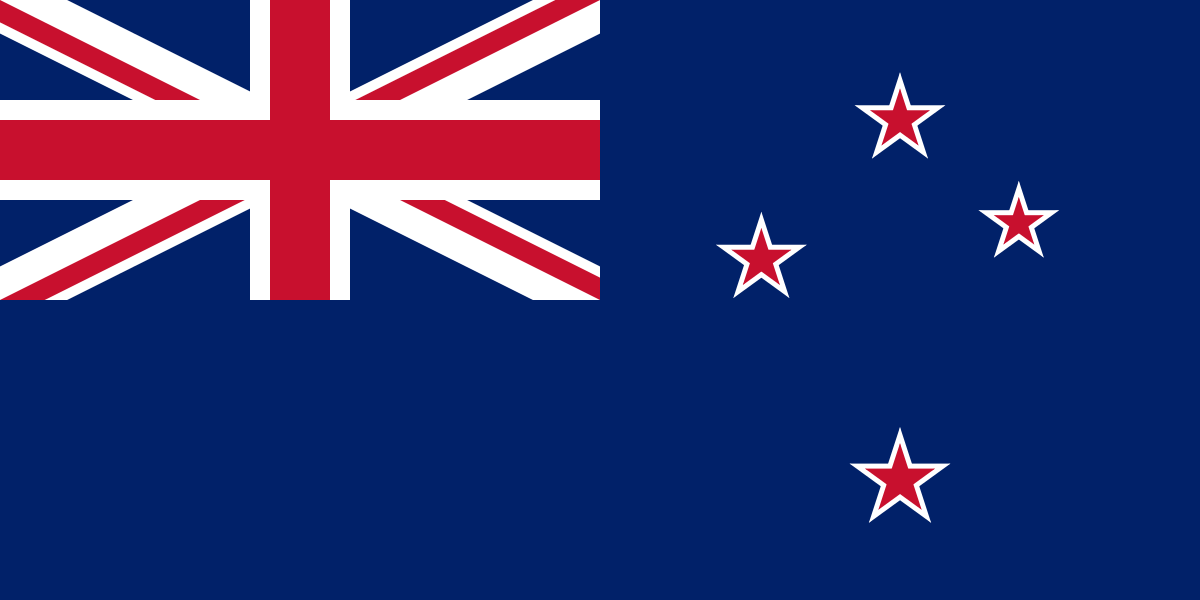
Adopted in 1902
| Capital | Wellington |
|---|---|
| Population | 5 338 500 inh. |
| Area | 267 710 km² |
| Population density | 19.9 inh./km² |
| Local time | --:-- |
| Language(s) | Maori, English, New Zealand Sign Language |
| Political system | Unitary parliamentary constitutional monarchy |
| National anthem | God Defend New Zealand + God Save the Queen |
| Currency | New Zealand dollar (NZD) |
| Maritime borders | Tasman Sea, Pacific Ocean |
The flag: history and symbolism
Flag History
Before British colonisation, Māori chiefs from the north of the North Island adopted a first flag in 1834, that of the United Tribes of New Zealand, so that their merchant ships could be identified in ports.
The current flag derives from the British Blue Ensign bearing the Southern Cross, used by colonial government ships from 1869. It officially became New Zealand's national flag in 1902.
The flag is now protected by the Flags, Emblems, and Names Protection Act 1981, which sets out its design and use.
Meaning of Colours & Emblems
The two elements of the New Zealand flag have a clear meaning:
- Union Jack: placed in the canton, it recalls the country's colonial history and its ties with the United Kingdom.
- Southern Cross: its four red stars edged in white place New Zealand in the South Pacific, under the skies of the southern hemisphere.
- Blue field: it evokes the ocean surrounding the islands and the sky.
Anecdotes & Fun Facts
In 2015 and 2016, New Zealand held two referendums on a possible change of flag. The chosen alternative, a silver fern designed by Kyle Lockwood, was finally rejected in March 2016: 56.6% of voters chose to keep the current flag.
The New Zealand flag is often confused with that of Australia, which has white stars and a large seven-pointed star beneath the Union Jack, absent from the New Zealand flag.
The Māori flag (Tino rangatiratanga), black, white and red, designed in the late 1980s, has been recognised since 2009 as the flag of the Māori people and as such flies on some public buildings.
Similar Flags Around the World

Sport and history
Olympic Games
Frequently asked questions
What is the capital of New Zealand?
Wellington is the capital of New Zealand.
What do the colours of the flag of New Zealand mean?
The two elements of the New Zealand flag have a clear meaning: Union Jack: placed in the canton, it recalls the country's colonial history and its ties with the United Kingdom. Southern Cross: its four red stars edged in white place New Zealand in the South Pacific, under the skies of the southern hemisphere. Blue field: it evokes the ocean surrounding the islands and the sky.