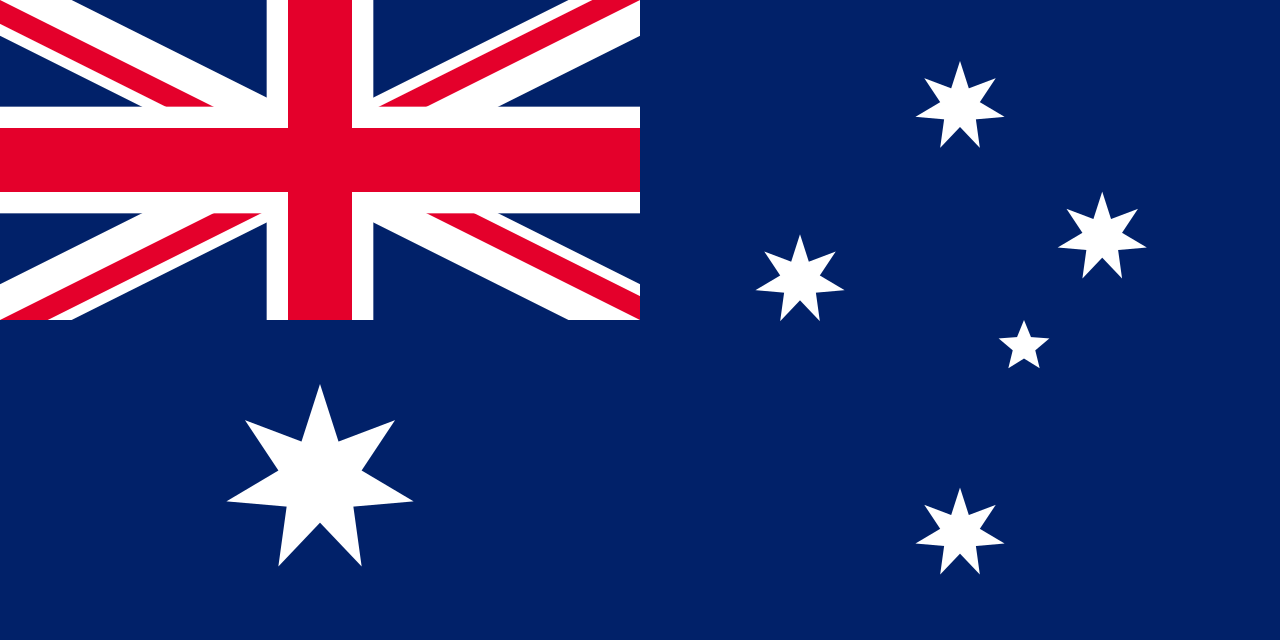
Adopted in 1901
| Capital | Canberra |
|---|---|
| Population | 27 204 809 inh. |
| Area | 7 741 220 km² |
| Population density | 3.5 inh./km² |
| Local time | --:-- (multiple time zones) |
| Language(s) | English |
| Political system | Federal parliamentary constitutional monarchy |
| National motto | Advance Australia Fair |
| National anthem | Advance Australia Fair |
| Currency | Australian dollar (AUD) |
| History | View timeline |
| Maritime borders | Coral Sea, Indian Ocean, Arafura Sea, Tasman Sea, Timor Sea |
The flag: history and symbolism
Flag History
The Australian flag came out of a competition held in 1901, the year the Australian colonies federated. It received more than 32,000 entries, and five entrants who had submitted almost identical designs were named joint winners, among them a 14-year-old schoolboy, Ivor Evans, and an artist from Perth, Annie Dorrington.
The flag was flown for the first time on 3 September 1901, at the Royal Exhibition Building in Melbourne. That date has become Australian National Flag Day.
The Commonwealth Star, also known as the Star of Federation, at first had only six points, one for each state; a seventh was added in 1908 to represent the territories. The Flags Act 1953 officially made the blue flag the national flag of Australia.
Meaning of Colours & Emblems
Each of the three elements of the Australian flag has a precise meaning:
- Union Jack: placed in the canton, it recalls the historical ties with the United Kingdom and the British origins of the Australian colonies.
- Commonwealth Star: placed beneath the Union Jack, it has seven points, six for the founding states and one for the territories.
- Southern Cross: this constellation, visible throughout the southern hemisphere, places Australia in the world. Four of its stars have seven points, while the smallest has five.
Anecdotes & Fun Facts
The Australian flag is often confused with that of New Zealand, which also features a blue field, the Union Jack and the Southern Cross. The New Zealand flag, however, has only four red stars edged in white and no Commonwealth Star.
Since 1995, two other flags have held the status of official flags of Australia: the Aboriginal flag, designed in 1971 by the artist Harold Thomas, and the Torres Strait Islander flag, designed by Bernard Namok.
The presence of the Union Jack is regularly debated in Australia, particularly among supporters of a republic, who propose replacing it with a flag with no reference to the United Kingdom.
Similar Flags Around the World


Sport and history
Athletes
- Anna Meares
- Cadel Evans
- Michael Matthews
- Michael Rogers
- Phil Anderson
- Richie Porte
- Robbie McEwen
- Ryan Bayley
- Simon Gerrans
- Stuart O'Grady
- Jack Brabham
- Mick Doohan
- Jessica Fox
- Keegan Palmer
- Matthew Wearn
- Ariarne Titmus
- Emma McKeon
- Ian Thorpe
- Kaylee McKeown
- Stephanie Rice
- Roy Emerson
- Craig Alexander
- Mirinda Carfrae
Olympic Games
History
Frequently asked questions
What is the capital of Australia?
Canberra is the capital of Australia.
What do the colours of the flag of Australia mean?
Each of the three elements of the Australian flag has a precise meaning: Union Jack: placed in the canton, it recalls the historical ties with the United Kingdom and the British origins of the Australian colonies. Commonwealth Star: placed beneath the Union Jack, it has seven points, six for the founding states and one for the territories. Southern Cross: this constellation, visible throughout the southern hemisphere, places Australia in the world. Four of its stars have seven points, while the smallest has five.