Adopted in 1911
| Capital | Lisbon |
|---|---|
| Population | 10 701 636 inh. |
| Area | 92 230 km² |
| Population density | 116.0 inh./km² |
| Local time | --:-- |
| Language(s) | Portuguese |
| Political system | Unitary semi-presidential constitutional republic |
| National anthem | A Portuguesa (The Portuguese) |
| Currency | Euro (EUR) |
| History | View timeline |
| Land borders | Spain |
| Maritime borders | Atlantic Ocean |
The flag: history and symbolism
Flag History
Portugal's current flag was born of the revolution of 5 October 1910, which overthrew the monarchy and proclaimed the Republic. The blue and white flag of the constitutional monarchy was then abandoned in favour of a green and red flag, colours associated with the republican movement since the failed uprising in Porto on 31 January 1891.
The new design was drawn up by a commission whose members included the painter Columbano Bordalo Pinheiro. Presented to the public on 1 December 1910, it was officially adopted by the National Constituent Assembly on 19 June 1911.
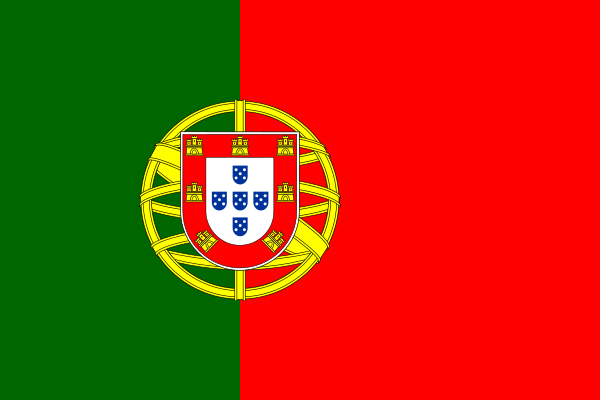
The flag is divided vertically: two fifths green at the hoist and three fifths red. Where the two colours meet stand a yellow armillary sphere and the shield of the arms of Portugal.
Meaning of Colours & Emblems
The report of the 1910 commission gave the elements of the flag an interpretation that remains the most widely accepted:
- Green: hope.
- Red: courage and the blood shed by those who died for the homeland.
- Armillary sphere: a navigational instrument and the personal emblem of King Manuel I, it recalls the Age of Discovery of the 15th and 16th centuries.
- Shield: its red border bears seven castles, associated with the conquest of the Algarve; in the centre, five small blue shields (the quinas), each charged with five white bezants, evoke the founding of the kingdom by Afonso I.
Anecdotes & Fun Facts
According to a tradition that emerged at the end of the Middle Ages, the five quinas represent the five Moorish kings defeated by Afonso Henriques at the Battle of Ourique in 1139, and the bezants the five wounds of Christ, who is said to have appeared to him before the battle.
The armillary sphere had already appeared on the flag of the United Kingdom of Portugal, Brazil and the Algarves, created in 1816 while the Portuguese court was based in Rio de Janeiro, where it represented Brazil.
The choice of green and red was contested at first: part of public opinion, attached to blue and white, saw it as too abrupt a break with the country's history. More than a century later, this flag has become one of Portugal's most popular symbols, not least in the stands of football grounds.
Flags of Neighbouring Countries

Sport and history
Clubs
Competitions
Olympic Games
History
Frequently asked questions
What is the capital of Portugal?
Lisbon is the capital of Portugal.
What do the colours of the flag of Portugal mean?
The report of the 1910 commission gave the elements of the flag an interpretation that remains the most widely accepted: Green: hope. Red: courage and the blood shed by those who died for the homeland. Armillary sphere: a navigational instrument and the personal emblem of King Manuel I, it recalls the Age of Discovery of the 15th and 16th centuries. Shield: its red border bears seven castles, associated with the conquest of the Algarve; in the centre, five small blue shields (the quinas), each charged with five white bezants, evoke the founding of the kingdom by Afonso I.
Which countries border Portugal?
Portugal shares land borders with: Spain.